24/7 Support : info@razorse.com | WhatsApp : +91-7011221090

Angular With ASP.Net Core- Full Stack Combination

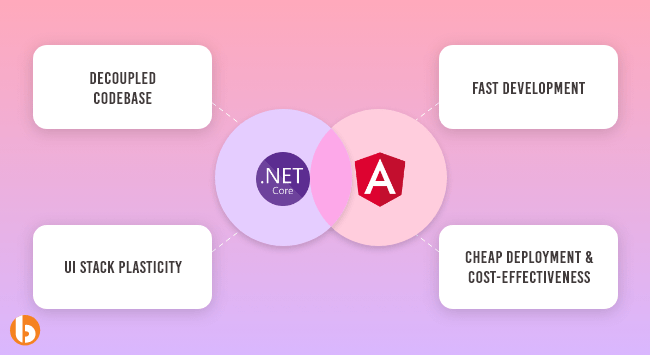
Angular with ASP.NET Core is a powerful full-stack combination that allows developers to build modern web applications with ease. This combination brings together the benefits of a robust server-side framework like ASP.NET Core with the flexibility and rich user interface capabilities of Angular.

Angular is a popular front-end framework developed and maintained by Google. It provides a comprehensive set of tools and features for building dynamic and responsive web applications. With Angular, developers can create reusable components, implement powerful data binding, handle routing, and perform efficient state management. Angular also has a vibrant ecosystem with a vast number of libraries and extensions that can enhance productivity and extend the framework’s capabilities.

On the other hand, ASP.NET Core is a cross-platform, open-source web framework developed by Microsoft. It enables developers to build high-performance web applications using the C# programming language. ASP.NET Core offers a wide range of features, including robust routing, middleware support, dependency injection, and seamless integration with various data storage solutions. It also provides a secure and scalable infrastructure for hosting web applications.

When combined, Angular and ASP.NET Core provide a powerful full-stack solution for web development. Here are some key advantages of using this combination:

  • Separation of concerns: Angular handles the client-side logic and user interface, while ASP.NET Core focuses on server-side processing and data management. This clear separation of concerns enables developers to work on different parts of the application independently, improving productivity and maintainability.
  • Enhanced user experience: Angular’s powerful data binding and component-based architecture allow for the creation of highly interactive and responsive user interfaces. With ASP.NET Core handling server-side operations, developers can build applications that deliver a smooth and engaging user experience.
  • Rapid development: Angular provides a rich set of pre-built components, which can be easily customized and reused across different parts of the application. This accelerates development and reduces the need for writing repetitive code. ASP.NET Core, with its extensive libraries and tooling, further boosts development speed, allowing developers to focus on building core application logic.
  • Scalability and performance: ASP.NET Core’s performance optimizations, such as its lightweight and modular architecture, enable the development of high-performance web applications. Angular’s lazy loading and tree shaking features further contribute to improved application performance by minimizing the size of JavaScript bundles and loading only the required modules.
  • Strong ecosystem and community support: Both Angular and ASP.NET Core have large and active communities, providing extensive documentation, tutorials, and community-driven resources. This support ecosystem ensures that developers can easily find solutions to problems, learn best practices, and stay up to date with the latest advancements in web development.

In conclusion, combining Angular with ASP.NET Core offers a powerful and efficient full-stack solution for building modern web applications. This combination leverages the strengths of both frameworks, allowing developers to create highly interactive and performant applications with ease. Whether you’re a front-end developer looking to work with a robust back-end framework or a back-end developer seeking a modern and feature-rich front-end framework, Angular with ASP.NET Core is a compelling choice for full-stack development.

Cross-platform App Development- Using React Native or Kotlin

React Native & Kotlin are two of the foremost cross-platform development tools used by the developers to create robust mobile apps.

React Native

Originally released on 26th March 2015, React Native is JavaScript framework. The developer’s community, i.e., Facebook formed React Native for writing real, native mobile applications for Android & iOS besides recycling codes across mobile & web apps. It figures user interfaces that are perfectly designed for mobile platforms. React Native aids developers to build truly native mobile applications with the help of their classic favourite, JavaScript.

  • Supported Platforms: React Native supports iOS 8+ versions & Android 4.0.3+.
  • Special Benefit: React Native serves high-code reusability among platforms. Furthermore, the RN developer community has created a huge number of libraries which can be used by the developers as building blocks, so boosting the development procedure.
  • When to Use: Opt for React Native while you are willing to have a common code for web, desktop or mobile.
  •  Pricing: Since React Native is open-source, creators can hire it free of cost.

Kotlin

Developed, designed, as well as sponsored by JetBrains, Kotlin is programming language. It works on JVM. It was when Google recommended Kotlin as the authorized language of android studio, that it began gaining popularity constantly. Kotlin is devoted to building the finest IDE tools.

In addition, it offers outstanding support in a distinct development environment such as an Android Studio. When you select Kotlin for your business application development, you can aid your developer advance support across numerous IDEs and tools needed to create your Android project. Kotlin holds an extremely clear codebase. It is brief and precise, thus leaving very few probabilities of potential errors & facilitating stable code in creation.

  • Supported Platforms: Being an android companionable language, Kotlin can run unbelievably across all iOS 8+ & Android versions.
  •  Special Advantage: Since Kotlin is not a software development equipment but an all-purpose programming language, developers don’t need to port the whole app to it.
  • When To Use: Perfect for android app development.
  •  Pricing: Its free of cost

Speaking about performance, React Native provides a native-like experience to the developers. It enables developers to build apps with the help of native modules & JavaScript. It is fast, scalable & delivers a native feel as well as looks on both platforms, i.e., iOS and Android.

Implementation of AI and ML with .NET Applications

In today’s digital era, Artificial Intelligence (AI) & Machine Learning (ML) are turning to be more and more important to digital operations. Every business wants to authorize its IT ecosystem by incorporating AI & ML with .NET applications and other enterprise solutions and apps. 

Reasons to Implement AI & ML in .NET apps

Businesses should look at AI & ML using the lenses of commercial capabilities, performance and productivity. By integrating AI and ML with .NET applications, companies can automate as well as optimize workflows, personalize experiences and gain new visions into their data, which can aid increase productivity and efficiency.

Following are a few reasons why you should integrate AI & ML in .NET apps-

  • Process Automation – By incorporating ML and AI in .NET apps, you acquire an opportunity to flawlessly automate digital & physical tasks that are usually repetitive, error-prone and time-consuming. It permits employees to emphasis on other critical tasks & increase efficiency. For example: transferring consumer data from individual systems to centralized server.
  • Predictive Analytics – Using AI algorithms & ML models, dot NET apps can detect fine patterns in a large mass of data and understand their meaning. Integrating ML and AI with .NET apps helps industries predict the prospective action a client or user would take. Predictive insights permit companies to make informed decisions & be prepared for what will happen shortly. For example: predicting if a client is going to purchase a particular product or not.
  • Personalization – Combining AI & ML with .NET apps let companies to customize a user journey. It empowers .NET web apps to track information about a user & your business requirement. It can comprise demographics, tastes, interests, previous history, personal info, and more. For example: displaying modified content to the user, guaranteeing accurate or range of personal interest to present to a user visiting a site for second time.
  • Advanced Analytics – ML and AI with .NET apps enable the processing of huge amounts of intricate data sets in real-time to create precise responses. Progressive analytics enable the businesses to make data-driven decisions by offering specific insights and endorsements. For instance: sentiment analysis is one-way, as well as advanced analytics is used for examining customer feedback & gaining insights into their opinions, satisfaction and preferences.

Bottom Line-

The sphere of software development is continually evolving, and with it, the technologies and tools used to create apps. One of the newest trends in software development is integration of AI and ML with .NET apps. It offers a lot of benefits for users and businesses. AI & ML can increase functioning by automating routine tasks, improving workflows, and delivering predictive insights. It can improve effectiveness by personalizing experiences & providing real-time data investigation.

The Right Framework for Your iOS App Development- Flutter vs Swift

Flutter is an open-source UI software kit formed by Google which permits cross-platform app development with a single codebase. But Swift is a high-level, all-purpose, multi-paradigm, compiled language introduced as a substitute for Apple’s conventional programming language which is Objective-C.

Comparison-

  • Integration & Development – For Integration & Development also, both Swift & Flutter are considerable. Flutter has many plugins & packages you can integrate into apps. Plus, it permits the integration of third-party services such as Google Maps and Firebase. Swift also has several system frameworks and APIs that help develop effective iOS apps. Additionally, Swift along with XCode IDE provides many higher tools and qualities for iOS app development.
  • Development Time or Speed to Market – ‘Swift’ the name itself means swiftness – swiftness in terms of development speed & agility. Being more accessible and having a smaller learning curve, it greatly increases the speed of iOS app development. The XCode command line permits to evaluate the Swift Native iOS application development time, that is displayed after the expansion process is finished, and the build command is implemented from product menu. Swift also provides a varied range of system APIs & frameworks that accelerates the development speed or time to the market.
  • Application Size – Flutter has a compacted runtime that aids building small & fast mobile apps with limited expenditures. It has a varied range of tools & optimizations like tree sharing as well as code spitting which aids to further decrease the application size. Swift being native iOS framework assists build small & efficient iOS apps. Its compiler supports to optimize functioning and decrease size of the app. It also provides a wide range of optimization options like whole-module & link-time optimization. These add to further lessen the size of Swift apps.
  • Performance – If budget is not your restriction and you want to have separate apps developed for every platform then Swift is your answer, being a native framework, it gives greater efficiency & helps deliver quick, smooth, and reliable apps. Swift produces extremely optimized code & offers a set of system APIs, that can boost app performance. However, if you demand for a framework along with cross-platform functionality which offers better cost productivity, then Flutter is similarly efficient to make iOS apps. Flutter uses layered building that reduces the overhead of platform-specific APIs, resultant in better functioning.

In conclusion, both Flutter & Swift are outstanding choices for mobile application development, as well as the decision on which one to use depends on your particular needs & preferences. Eventually, the choice among the two depend on your primacies and the requirements of your application.

CodeIgniter vs Laravel- A Comparison

Laravel is an open-sourced framework based on Symfony & written in PHP that provides reusable PHP libraries or components. Laravel is recognized for its excellent HTML authentication, server-side managing of routing, templating, & a lot more.

CodeIgniter is robust PHP framework with minimal digital footprint produced for the developers looking for a rich still simple toolkit to make full-featured web applications. CodeIgniter gives no dependency & has absolute freedom on Model View Controller (MVC) design. Besides, CodeIgniter allows third-party plugins which furthermore ease the execution of complex functionalities.

Laravel vs CodeIgniter Real-Life Usage Cases

Laravel is a multipurpose PHP framework, which means that most types of apps could be constructed with the backend framework. From web applications to CMS to e-Commerce sites & API development to prototyping & microservices, Laravel has its trails universally.

Some huge organizations using Laravel are:

  • GitHub Education
  • Toyota
  • BBC
  • World Walking
  • Union Bank of Philippines

Like Laravel, CodeIgniter is also a versatile PHP backend framework which helps to improve small-to-medium-size sites, custom web applications, e-commerce sites, learning projects and agile prototyping.

Some large organizations using CodeIgniter are:

  • BirdView
  • Wisesight
  • Accenture
  • Esummarizer.com
  • Ola

CodeIgniter vs Laravel for the Beginners

The fight between Laravel & CodeIgniter for the beginners depends on following significant points:

  • Laravel is complicated to learn, whereas CodeIgniter has an easy studying curve.
  • Laravel has big community help than CodeIgniter, resultant in more obtainability of resources for the newbies.
  • Laravel’s code institute is better than CodeIgniter’s because of the difference in architectural pattern & understanding of it.
  • For the beginners, what matters most is the accessibility of features to avoid making from scratch, and that is what Laravel proposes.
  • Both Laravel & CodeIgniter build apps at a faster pace because of the availability of descriptions and minimalistic plan, respectively.

CodeIgniter Vs Laravel DBMS Support:

Why Use React Native for Mobile App Development?

React Native is ideal for mobile app development. From the opinion of cross-platform compatibility to scalable, stable, and high-performing applications, React Native is more suitable than creating native & hybrid apps. Creating mobile apps with React Native guarantees a smooth & responsive user-interface and could easily integrate third-party plugins & APIs.

Let us take a closer look at React Native’s interesting features to have more belief on why to use React Native:

1. Create Mobile Applications that are indistinguishable from Apps – React Native permits your business to have mobile apps similar to those in Java or Objective-C. React Native associations these UI Components with JavaScript & React, with the same UI Components as Android and iOS. Apps made with React Native are responsive and pleasant.

2. Tried by Multiple Developers – This language has a bigger community, and numerous businesses use React Native for mobile application development. React Native fame has augmented due to its important updates & improvements, improved performance, newest features, & address bugs.

3. Seamless Experiences for Android & iOS – React Native is competent in delivering class platforms for both iOS and Android platforms. Using mechanisms, React Native safeguards an engaging and seamless user experience through various devices, making it the top choice for building superior apps.

4. Reusability – React Native permits sharing app logic across 2 platforms, letting the developers to reuse about 70 percent of code amid iOS and Android.

5. Native Module – Building a native module, or an association between your JS code & host platform allows your developer to quickly and easily make platform-specific code for several modules in your app to benefit from the platform-specific APIs. This is feasible with React Native. A native unit is extremely easy to write. Moreover, Facebook has clearly verified this.

6. Multi-Platform Assistance – React Native refutes the necessity to select between iOS and Android. This is since it will allow your developer to sustain one codebase for both the platforms. Consequently, rather than writing equivalent codebases in Swift and Java, your app developer can use the same codebase. React Native indisputably minimizes cross-compatibility subjects and increases the user experience.

7. Extend Web Support – The open-source framework has protracted its support for web with React native library. it is an influential web library that permits developers to create mobile apps with React Native components & extend their functionality to the web. The newly released library shares a noteworthy code that offers unified cross-platform development & efficient solutions.

8. Cost-Effectiveness – An additional advantage of React Native development is its augmented cost-effectiveness. This is as the programmers may build programs for both Android and iOS with the same code.