24/7 Support : info@razorse.com | WhatsApp : +91-7011221090

https://razorse.com/blog/digital-skill-matrix-replacing-excel-in-manufacturing-plants/

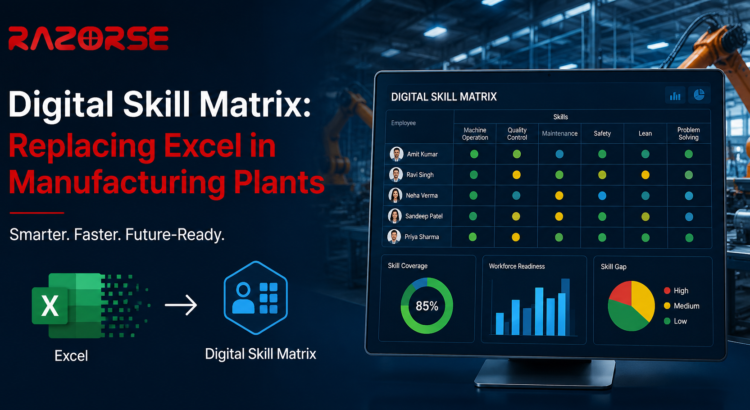
Digital Skill Matrix: Replacing Excel in Manufacturing Plants

Introduction

Manufacturing industries are rapidly moving toward automation, smart factories, and Industry 4.0-driven operations. While production systems are becoming more advanced, many organizations still rely on outdated Excel sheets to manage workforce skills, certifications, training records, and competency tracking. Although spreadsheets may have worked in the past, they are no longer capable of supporting the speed, complexity, and scale of modern manufacturing environments.

Today’s manufacturing leaders require real-time workforce visibility, faster decision-making, better compliance management, and data-driven workforce planning. This is where digital skill matrix systems are becoming essential.

A digital skill matrix helps organizations track employee competencies, identify skill gaps, improve productivity, and simplify workforce management through a centralized digital platform.

The Challenges of Manual Skill Tracking

In many manufacturing plants, workforce competency management still depends heavily on spreadsheets and manual reporting systems. HR teams and plant managers often maintain separate Excel files for certifications, machine handling capabilities, safety training records, and employee skill levels. Over time, this creates operational inefficiencies and data inconsistencies.

One of the biggest problems with Excel-based tracking is the lack of real-time updates. Employee data can quickly become outdated, making it difficult for management teams to identify current workforce capabilities accurately. Manual data entry also increases the chances of human errors, duplicate records, and missing information.

During audits or compliance reviews, retrieving updated workforce records from multiple spreadsheets becomes time-consuming and stressful. In industries such as automotive and engineering manufacturing, where compliance and safety standards are critical, this can create serious operational risks.

Why Workforce Skill Visibility Matters

Modern factories require highly skilled and adaptable employees capable of working with automated systems, robotics, ERP platforms, and smart manufacturing technologies. As Industry 4.0 adoption increases, workforce competency becomes directly linked to operational efficiency and productivity.

Without clear visibility into employee skills and certifications, organizations struggle with improper workforce allocation, delayed production schedules, training inefficiencies, compliance risks, and reduced productivity.

A digital skill matrix enables organizations to manage workforce readiness proactively instead of reacting to operational challenges after they occur.

What is a Digital Skill Matrix?

A digital skill matrix is a centralized platform that tracks workforce competencies, certifications, training progress, and employee proficiency levels in real time. Unlike static spreadsheets, digital systems provide automated updates, centralized visibility, and actionable insights for workforce planning.

These systems help organizations monitor employee skills across departments, identify competency gaps instantly, track training and certification status, improve workforce planning, simplify compliance management, and generate real-time reports and dashboards.

This creates a more structured and intelligent approach to workforce management.

Key Benefits of Digital Skill Matrix Systems

One of the biggest advantages of digital skill matrix platforms is improved workforce productivity. Managers can instantly identify skilled employees for specific operations, reducing delays and improving resource utilization.

Digital systems also strengthen compliance management by automatically tracking certifications, safety training renewals, and mandatory workforce requirements. Instead of manually monitoring expiry dates, organizations receive automated alerts and updates.

Another major benefit is faster employee upskilling. By identifying skill gaps clearly, HR and training teams can create targeted learning programs instead of conducting generalized training sessions. This improves workforce competency while reducing unnecessary training costs.

Additionally, digital platforms reduce dependency on manual administrative work. Centralized systems eliminate the need for maintaining multiple spreadsheets and improve collaboration across departments.

How DOJO 2.0 Supports Workforce Digitization

As manufacturing operations become more complex, organizations require intelligent workforce management solutions that align with Industry 4.0 goals. DOJO 2.0 is designed to help manufacturing companies digitize workforce competency management efficiently.

The platform enables organizations to track employee skills, certifications, training records, and workforce readiness through a centralized digital system. Instead of relying on disconnected spreadsheets, companies gain real-time visibility into workforce performance and competency levels.

DOJO 2.0 helps organizations digitize workforce management processes, improve operational visibility, identify workforce gaps quickly, strengthen compliance readiness, improve workforce productivity, and support data-driven decision-making.

This creates a smarter and more scalable workforce management ecosystem for modern manufacturing plants.

Real-World Manufacturing Scenario

Consider an automotive manufacturing plant operating multiple production lines across different shifts. Employees may require different certifications for machine handling, safety operations, and quality processes. Managing this information manually across spreadsheets becomes highly inefficient.

With a digital skill matrix, supervisors can instantly identify which employees are certified for specific machines, which workers require retraining, which teams have competency shortages, and which certifications are about to expire.

This improves workforce allocation, minimizes production disruptions, and ensures operational continuity.

The Future of Workforce Management

The future of manufacturing will depend heavily on workforce digitization and intelligent operational systems. Companies that continue relying on spreadsheets may struggle to manage growing operational complexity effectively.

Digital workforce management systems are becoming essential for Industry 4.0 transformation, smart factory implementation, AI-driven manufacturing operations, workforce optimization, and compliance management.

Organizations investing in workforce digitization today will build stronger operational foundations for the future.

Conclusion

Excel sheets are no longer sufficient for managing workforce competency in modern manufacturing environments. Digital skill matrix systems provide the visibility, efficiency, and intelligence required for effective workforce management.

By adopting platforms like DOJO 2.0, manufacturing organizations can improve productivity, strengthen compliance, reduce operational inefficiencies, and prepare their workforce for Industry 4.0 transformation.

Looking to replace manual workforce tracking with a smarter digital solution? Connect with Razorse Software to explore how DOJO 2.0 can help your manufacturing plant digitize workforce competency management and improve operational efficiency.


How to Improve Lead Quality Without Increasing Your Marketing Budget

In today’s digital landscape, generating leads is no longer the biggest challenge for businesses. The real issue lies in generating leads that actually convert. Many companies invest heavily in marketing campaigns, only to find that a large portion of their leads lack intent, relevance, or buying potential. The good news is that improving lead quality does not require increasing your marketing budget. With the right strategy, focus, and optimization, businesses can attract more meaningful leads while using existing resources more effectively.

Understanding What Lead Quality Really Means

Lead quality refers to how closely a prospect aligns with your ideal customer profile and how likely they are to convert into a paying customer. A quality lead typically has a clear need, decision-making authority, and genuine interest in your solution. When businesses fail to define this clearly, marketing efforts often prioritize quantity over relevance, resulting in wasted time and lower conversion rates. Improving lead quality begins with clarity-knowing exactly who your solution is meant for and why they need it.

Focusing on the Right Audience Instead of a Bigger Audience

One of the most common mistakes businesses make is trying to reach everyone. Broad targeting may increase traffic, but it rarely brings in serious buyers. Instead of expanding reach, narrowing your audience based on industry, role, company size, and pain points helps attract prospects who are more likely to engage. When messaging speaks directly to a specific audience, it resonates more strongly and naturally filters out low-intent users-without increasing ad spend.

Key Strategies to Improve Lead Quality Without Increasing Budget

Improving lead quality is more about precision than promotion. When marketing efforts are aligned with clear objectives, results improve naturally. Businesses that focus on clarity in messaging and intent in targeting often see higher conversion rates with the same budget.

Key focus areas include:

  • Clearly defining your ideal customer profile to attract relevant prospects
  • Narrowing targeting instead of expanding reach
  • Using precise messaging on landing pages to filter low-intent users
  • Creating high-value content that attracts informed, high-intent prospects
  • Aligning sales and marketing teams on lead qualification criteria

These strategies help ensure that marketing efforts attract prospects who are genuinely interested and better suited for your offerings.

Creating Landing Pages That Qualify Leads Automatically

Landing pages play a crucial role in determining lead quality. While attractive design is important, clarity matters more. When landing pages clearly communicate who the solution is for, what problems it solves, and what value it delivers, they act as a natural filter. Including qualifying form fields such as company size or business needs further ensures that only serious prospects move forward. Even if total submissions decrease slightly, the quality of leads improves significantly.

Using Content to Attract High-Intent Prospects

Content marketing is one of the most effective ways to improve lead quality without increasing spend. Blogs, case studies, and solution-focused content educate prospects before they reach out. This self-qualification process ensures that leads who engage with your business already understand your value proposition. As a result, content-driven leads tend to convert faster, require less nurturing, and show stronger buying intent.

How to Maximize Conversions from Existing Leads

Often, businesses assume leads are low quality when the real issue lies in how they are handled. Slow responses, generic follow-ups, and lack of personalization can cause promising prospects to disengage. Improving how leads are nurtured can significantly increase conversion rates without spending more on acquisition.

To improve conversions from current leads:

  • Respond faster to inquiries while interest is high
  • Personalize follow-ups based on prospect behavior and intent
  • Track conversion-focused metrics instead of vanity metrics
  • Strengthen lead nurturing workflows to build trust over time
  • Leverage referrals and customer success stories

Small improvements in follow-up strategy often deliver greater impact than generating new leads.

Measuring What Actually Impacts Lead Quality

Tracking the right metrics is essential for sustainable improvement. Instead of focusing on clicks or impressions, businesses should analyze lead-to-conversion ratios, sales acceptance rates, and revenue contribution by channel. These insights help identify which efforts bring in serious buyers and which generate noise. Data-driven decisions allow teams to optimize existing strategies rather than increase spend.

Final Thoughts

Improving lead quality is not about bigger budgets-it’s about smarter execution. By focusing on clarity, targeting, content, and follow-up strategies, businesses can attract leads that are more relevant, engaged, and ready to convert.

At Razorse Software, we help businesses build intelligent digital strategies that prioritize quality over quantity. Our approach ensures you attract the right audience, convert high-intent leads, and drive sustainable growth-without unnecessary marketing spend.

How to Improve User Engagement Through App Design

In today’s mobile-first world, having an app isn’t enough. What truly matters is how well your app engages its users. Engagement is more than just screen time – it’s about creating meaningful experiences that keep users coming back. A well-designed app should feel intuitive, personal, and satisfying to use. It’s this user-first mindset that sets successful apps apart from the rest.

At Razorse Software, we’ve seen firsthand how thoughtful design directly influences user engagement. The visual appeal, ease of navigation, loading speed, and interactive elements – all play a vital role in holding the user’s attention and turning casual users into loyal advocates.

Let’s explore how app design can become the driving force behind improved user engagement.

Understanding the User is Key

The foundation of a highly engaging app lies in how well you understand your audience. Before jumping into colors and layouts, take time to research your users’ needs, challenges, and behaviors. What are they trying to accomplish? Where do they typically drop off? Design must begin with empathy – only then can you create experiences that feel tailored and intuitive.

A user-centric design approach ensures that the app serves a real purpose in the user’s life. Everything from the information architecture to the smallest interaction should reflect a deep understanding of user expectations. This relevance helps build trust and keeps users emotionally invested.

Simplicity Creates a Smoother Experience

When it comes to app design, less truly is more. Simplicity doesn’t mean dull design-it means giving users exactly what they need, when they need it, without overwhelming them. Clean interfaces, minimalistic layouts, and clear calls to action can dramatically improve usability.

Designing for simplicity also includes reducing the number of steps it takes to complete an action. Whether it’s signing up, making a purchase, or finding content-every tap should feel purposeful. Apps that are intuitive and easy to navigate automatically encourage longer sessions and frequent use.

Seamless Onboarding Builds Confidence

First impressions matter-and in the world of apps, that means your onboarding experience must be flawless. The first few screens are crucial for making users feel comfortable and guiding them toward key features. A confusing or lengthy onboarding can lead to immediate abandonment.

Effective onboarding should be short, visual, and value-driven. Consider using tooltips, quick walkthroughs, or animations to highlight how the app benefits the user. The goal isn’t to show off every feature upfront, but rather to help users discover them as they go, building confidence along the way.

Personalization Enhances Connection

We live in a world where users expect experiences to be tailored to them. By incorporating personalization into your app design, you can dramatically boost engagement. Whether it’s product recommendations, curated content, or personalized notifications, these touches show users that your app understands them.

Smart design leverages user data ethically to deliver relevance. Instead of treating all users the same, the app becomes a responsive environment that adapts based on individual behavior. This not only makes users feel seen but also increases the chances of them returning to your app regularly.

Visual Feedback and Microinteractions Matter

It’s often the small things that make a big difference. Microinteractions-like animations when a button is tapped, progress indicators, or visual confirmations-enhance the tactile feel of the app. These subtle design elements provide feedback and create a sense of control, which users appreciate.

Well-crafted microinteractions not only make the app feel alive, but also keep users engaged without them even realizing it. They smoothen transitions, provide clarity, and make the experience more enjoyable-leading to increased interaction time and better user retention.

Continuous Evolution Through Feedback

App design is never a one-time process. Trends evolve, user expectations change, and technology advances. Engaging apps are those that grow with their audience. By integrating feedback loops-through reviews, surveys, or in-app analytics-you can gain insights into what’s working and what’s not.

Use this feedback to constantly iterate and improve. Small tweaks based on real data, such as moving a button or changing the color of a call-to-action, can have a significant impact on engagement levels. Regular updates show users that the app is active, maintained, and worth their time.

Final Thoughts

Improving user engagement through app design isn’t about adding flashy elements or complex features-it’s about designing with purpose, clarity, and empathy. From the moment a user opens your app, their journey should be seamless, enjoyable, and rewarding. Every screen, interaction, and response should make them feel like they’re in the right place.

At Razorse Software, we understand that great design is not just about looking good-it’s about delivering real results. Our design and development teams work hand-in-hand to create apps that are not only visually stunning but also deeply engaging. Whether you’re building a new app or refining an existing one, we’re here to turn your vision into an experience users love.

How Startups Can Leverage AI to Scale Faster

In today’s competitive business landscape, startups need every advantage they can get to scale quickly and efficiently. Artificial Intelligence (AI) has emerged as a game-changer, offering automation, predictive analytics, and personalization that can help startups grow at an unprecedented pace. By integrating AI into various aspects of their business, startups can enhance customer experience, optimize operations, and make data-driven decisions. This blog explores how AI can be leveraged by startups to achieve rapid scalability.

1. Automating Repetitive Tasks

One of the biggest challenges for startups is managing routine and repetitive tasks, which consume valuable time and resources. AI-powered automation tools help eliminate inefficiencies by automating tasks like data entry, customer support, marketing outreach, and HR processes. Chatbots, for instance, can handle customer inquiries 24/7, reducing response times and freeing up human resources for more strategic activities. Similarly, AI-powered tools like Zapier and UiPath streamline workflows, improving overall productivity.

2. Enhancing Customer Experience with AI

AI-driven customer experience solutions have transformed how startups interact with their audience. From chatbots and virtual assistants to AI-powered recommendation engines, businesses can offer personalized experiences tailored to individual customers. Startups in the e-commerce and SaaS industries, for example, use AI to analyze user behavior and suggest products or services accordingly. AI-driven sentiment analysis also helps businesses understand customer feedback in real-time, enabling proactive improvements.

3. Data-Driven Decision Making

Data is the backbone of modern business strategies. AI algorithms can process vast amounts of data in real-time, providing actionable insights for startups. Predictive analytics tools help businesses forecast market trends, optimize pricing strategies, and identify potential customer segments. AI-powered analytics platforms like Tableau, Google Analytics, and Power BI empower startups to make informed decisions that drive growth.

4. AI-Powered Marketing and Sales Strategies

AI has revolutionized marketing and sales by enabling hyper-targeted campaigns and predictive lead scoring. AI-driven marketing tools analyze customer behavior, engagement patterns, and demographics to craft personalized marketing messages. Platforms like HubSpot, Marketo, and Salesforce leverage AI to optimize email marketing, ad placements, and social media campaigns, ensuring maximum ROI. Additionally, AI chatbots assist in lead qualification, improving conversion rates and reducing sales cycle times.

5. Optimizing Product Development

Startups can leverage AI in product development to enhance innovation and reduce time-to-market. AI-driven research tools analyze market trends, customer feedback, and competitor strategies to identify gaps and opportunities. AI-based prototyping tools, such as generative design software, enable startups to create and test product variations rapidly. In the software industry, AI-powered code generators and testing tools improve development efficiency and reduce errors.

6. Strengthening Cybersecurity

Cybersecurity is a growing concern for startups handling sensitive data. AI-driven security solutions can detect and mitigate threats in real-time. Machine learning algorithms identify patterns associated with cyberattacks, enabling proactive security measures. AI-powered tools like Darktrace and IBM Watson Security help startups safeguard their digital assets by continuously monitoring and responding to anomalies.

7. AI in Financial Management

Managing finances efficiently is crucial for startup growth. AI-powered financial tools assist in budgeting, expense tracking, and fraud detection. AI-driven accounting software like QuickBooks and Xero automate bookkeeping, reducing manual errors. Additionally, AI-driven fintech solutions help startups secure funding by analyzing business performance and creditworthiness, increasing their chances of obtaining loans or attracting investors.

8. Streamlining Recruitment and Talent Management

Hiring the right talent is essential for startup success. AI-driven recruitment platforms streamline the hiring process by analyzing resumes, conducting initial interviews, and shortlisting candidates based on predefined criteria. Tools like HireVue, LinkedIn Talent Solutions, and Pymetrics use AI to match candidates with job roles efficiently. Moreover, AI-powered HR analytics helps startups retain employees by identifying factors contributing to job satisfaction and engagement.

9. AI in Supply Chain and Logistics

For startups in retail, manufacturing, and logistics, AI optimizes supply chain operations. AI-driven demand forecasting enables businesses to predict inventory needs accurately, reducing wastage and stockouts. Automated warehouse management systems powered by AI improve efficiency and reduce operational costs. Additionally, AI-driven route optimization ensures timely deliveries, enhancing customer satisfaction.

10. Scaling Without Exponential Costs

Startups often struggle with scaling due to budget constraints. AI helps businesses expand without a proportional increase in costs. Cloud-based AI solutions eliminate the need for expensive infrastructure, making advanced AI capabilities accessible to startups. AI-driven process automation reduces the need for additional workforce, enabling startups to allocate resources more effectively.

The Future of AI for Startups

As AI technology continues to evolve, its applications for startups will expand further. Emerging AI trends like generative AI, AI-driven no-code/low-code platforms, and AI-powered business intelligence will provide even more opportunities for startups to innovate and scale. By staying ahead of AI advancements, startups can maintain a competitive edge and achieve sustainable growth.

How Razorse Software Can Help Your Startup Leverage AI

At Razorse Software, we specialize in AI-driven solutions tailored to help startups scale faster and more efficiently. From AI-powered chatbots and marketing automation to predictive analytics and cybersecurity solutions, we offer customized AI services to optimize your business operations. Our expertise in AI integration ensures that your startup leverages the latest technological advancements for maximum growth. Contact us today to explore how AI can transform your business!

How Technology is Powering the Future of E-Commerce

E-commerce has revolutionized the way businesses operate and consumers shop. With the rapid advancement of technology, the industry continues to evolve, offering enhanced experiences, improved security, and seamless transactions. As businesses compete to provide the best customer experience, technology plays a crucial role in shaping the future of e-commerce. From artificial intelligence (AI) to blockchain, the integration of innovative solutions is transforming how businesses connect with customers and manage operations.

1. Artificial Intelligence and Machine Learning

Artificial intelligence (AI) and machine learning (ML) have become integral to e-commerce. AI-driven chatbots provide instant customer support, enhancing user experience and engagement. Machine learning algorithms analyze user behavior and preferences to offer personalized product recommendations, increasing conversion rates and customer satisfaction. AI also streamlines inventory management, optimizing stock levels based on demand forecasting.

2. Augmented Reality (AR) and Virtual Reality (VR)

One of the biggest challenges in online shopping is the inability to physically inspect products before purchase. Augmented reality (AR) and virtual reality (VR) are bridging this gap by allowing customers to visualize products in real-world settings. AR-powered apps enable users to try on clothes, test furniture placement in their homes, or preview cosmetics, significantly reducing return rates and enhancing customer confidence.

3. Voice Commerce and Smart Assistants

The rise of voice commerce, powered by smart assistants like Amazon Alexa, Google Assistant, and Apple Siri, has transformed the way consumers shop. Voice search enables hands-free browsing and purchasing, making shopping more accessible and convenient. With voice recognition technology improving, businesses must optimize their platforms for voice search to cater to this growing trend.

4. Blockchain and Secure Transactions

Security and transparency are critical concerns in e-commerce. Blockchain technology addresses these issues by providing a decentralized and tamper-proof transaction system. Smart contracts ensure secure and automated transactions, reducing fraud and enhancing trust between buyers and sellers. Cryptocurrencies, powered by blockchain, are also gaining traction as alternative payment methods, offering faster and more secure transactions.

5. Big Data and Predictive Analytics

Data is the backbone of e-commerce, and big data analytics allows businesses to gain valuable insights into consumer behavior. By analyzing purchase history, browsing patterns, and customer feedback, companies can optimize their marketing strategies, improve customer engagement, and drive sales. Predictive analytics helps businesses anticipate demand, adjust pricing strategies, and personalize marketing campaigns for better outcomes.

6. 5G and Faster Connectivity

The introduction of 5G technology is set to revolutionize e-commerce by enabling faster data transfer, reduced latency, and improved mobile shopping experiences. With 5G, websites load quicker, video content streams seamlessly, and real-time interactions with chatbots and customer service representatives become more efficient. This enhances the overall shopping experience and encourages more consumers to shop online.

7. Internet of Things (IoT) in E-Commerce

The Internet of Things (IoT) is playing a significant role in optimizing e-commerce operations. IoT-enabled devices track inventory in real-time, automate warehouse management, and ensure efficient logistics. Smart sensors help monitor supply chains, reducing delays and improving customer satisfaction. IoT-driven personalization also enhances user experiences by suggesting relevant products based on usage data.

8. Sustainability and Green Technologies

As consumers become more environmentally conscious, businesses are integrating green technologies into their e-commerce strategies. Sustainable packaging, carbon footprint tracking, and AI-powered supply chain optimization reduce environmental impact. Companies leveraging eco-friendly technology not only contribute to sustainability but also enhance their brand reputation and customer loyalty.

9. Social Commerce and Influencer Marketing

Social media platforms are evolving into powerful e-commerce channels. With integrated shopping features, consumers can purchase products directly through platforms like Instagram, Facebook, and TikTok. Influencer marketing continues to drive engagement, with brands leveraging social proof to boost conversions. AI-driven analytics help businesses identify the right influencers and track campaign effectiveness.

10. The Future of E-Commerce

The future of e-commerce is driven by continuous innovation and technological advancements. Businesses must stay ahead of trends by embracing AI, AR, blockchain, and other emerging technologies. Personalized experiences, enhanced security, and seamless transactions will define the next era of online shopping. Companies that leverage technology effectively will gain a competitive edge and meet the evolving demands of digital consumers.

At Razorse Software, we specialize in developing cutting-edge e-commerce solutions that harness the power of technology. From AI-driven recommendations to secure blockchain transactions, our innovative approach ensures businesses stay ahead in the digital landscape. Stay tuned for more insights on the latest trends in e-commerce!

The Future of Cloud Computing in App Development

Cloud computing has fundamentally reshaped the landscape of application development, offering unparalleled scalability, efficiency, and cost savings. As businesses accelerate their digital transformation, cloud technologies continue to evolve, enabling developers to build and deploy applications faster, more securely, and at a lower cost. The future of cloud computing is being shaped by several emerging trends, each bringing new opportunities and challenges for developers and enterprises alike.

1. The Growing Popularity of Serverless Computing

Serverless computing is gaining traction as businesses look to optimize their resources. Platforms like AWS Lambda, Google Cloud Functions, and Azure Functions enable developers to focus purely on writing code, as the cloud provider automatically manages the underlying infrastructure.

With serverless computing, applications scale dynamically based on demand, reducing costs by ensuring that companies only pay for the computing resources they use. This trend is particularly beneficial for startups and enterprises looking to build cost-efficient, high-performance applications.

2. AI and Machine Learning Integration in the Cloud

Artificial Intelligence (AI) and Machine Learning (ML) are becoming integral to cloud computing, allowing developers to create more intelligent and data-driven applications. Cloud platforms now offer AI-powered services like natural language processing (NLP), image recognition, and predictive analytics.

For example, AWS SageMaker and Google AI Platform provide tools for building, training, and deploying AI models directly in the cloud. Businesses are increasingly leveraging AI to improve user experiences, automate decision-making, and enhance cybersecurity defences.

3. Multi-Cloud and Hybrid Cloud Strategies for Greater Flexibility

Enterprises are moving toward multi-cloud and hybrid cloud strategies to optimize performance, security, and cost-effectiveness. Relying on a single cloud provider can lead to vendor lock-in and service outages, whereas multi-cloud strategies allow businesses to distribute workloads across multiple providers like AWS, Microsoft Azure, and Google Cloud.

Hybrid cloud models, which combine private and public clouds, are also gaining traction, especially for industries that require strict regulatory compliance, such as finance and healthcare. These models offer greater flexibility, enabling companies to keep sensitive data on private servers while utilizing the public cloud for non-sensitive workloads.

4. Edge Computing: Reducing Latency for Real-Time Applications

As cloud applications demand real-time data processing, edge computing is emerging as a crucial technology. By processing data closer to the source-such as IoT devices, mobile phones, or autonomous vehicles-edge computing reduces latency and improves performance.

Cloud providers are now offering edge solutions to support low-latency applications like smart cities, AR/VR, and autonomous driving. Edge computing is expected to grow rapidly, enabling developers to build applications that require real-time decision-making without relying solely on centralized cloud servers.

5. Cloud-Native Development with Kubernetes and Microservices

Cloud-native development, which emphasizes microservices architecture and containerization, is transforming application development. Kubernetes has become the industry standard for orchestrating containers, allowing applications to be deployed seamlessly across different cloud environments.

Microservices architecture enables applications to be broken into smaller, independent services that can be developed, deployed, and scaled individually. This approach improves flexibility, resilience, and speed, making it ideal for modern applications that require frequent updates and enhancements.

6. Security and Compliance: The Need for Advanced Cloud Security

With the rapid adoption of cloud computing, security remains a top concern. Cloud providers are implementing advanced security measures such as zero-trust architectures, AI-driven threat detection, and enhanced encryption to protect sensitive data.

Key security trends include:

  • Zero Trust Security: Verifying every request before granting access, reducing the risk of insider threats and unauthorized access.
  • Confidential Computing: Encrypting data while it is in use, ensuring that even cloud providers cannot access it.
  • Automated Compliance Tools: Helping businesses meet regulatory requirements like GDPR, PCI-DSS, and HIPAA.

As cloud security threats continue to evolve, developers must prioritize security-first approaches in app development.

7. Sustainable Cloud Computing: A Push Toward Green Technology

With growing concerns about environmental sustainability, cloud providers are investing in energy-efficient data centers and carbon-neutral cloud operations. Green cloud computing focuses on reducing the carbon footprint by optimizing resource allocation, using renewable energy sources, and enhancing server efficiency.

Leading cloud providers such as AWS, Google Cloud, and Microsoft Azure have committed to sustainability initiatives, helping businesses adopt eco-friendly cloud solutions without compromising performance.

8. The Role of Quantum Computing in Cloud Development

While still in its early stages, quantum computing is set to revolutionize cloud computing by solving complex problems exponentially faster than classical computers. Cloud providers like IBM, Google, and Microsoft are investing in quantum computing research and making quantum processors accessible via the cloud.

In the future, quantum cloud computing could enable breakthroughs in cryptography, drug discovery, financial modeling, and artificial intelligence. Developers will need to adapt to this emerging technology to harness its full potential.

Conclusion

The future of cloud computing in app development is dynamic and full of possibilities. As trends like serverless computing, AI integration, edge computing, and quantum advancements continue to evolve, businesses must stay agile and leverage these technologies for innovation and efficiency. At Razorse Software, we specialize in cloud-powered app development, delivering secure, scalable, and future-ready solutions tailored to your business needs. Let’s build the next-generation digital experience together!