Introduction
Modern manufacturing plants generate massive volumes of operational data every day. Machines produce performance metrics, production lines generate output data, maintenance teams track downtime, and ERP systems manage inventory, procurement, and workforce operations. Despite having access to this information, many organizations still struggle to convert data into actionable business insights.
This is where manufacturing dashboards are transforming industrial operations.
Real-time dashboards help manufacturing organizations centralize critical operational data into a single visual interface, enabling faster decisions, improved productivity, and greater operational visibility. In today’s Industry 4.0 environment, dashboard-driven manufacturing is becoming a key driver of smart factory transformation.
The Problem with Data Silos
Many manufacturing plants still operate using disconnected systems across departments. Production teams, maintenance departments, HR units, and inventory managers often rely on separate software systems or spreadsheets that do not communicate efficiently with one another.
This creates major operational challenges. Leadership teams spend significant time manually collecting reports before making decisions. By the time the data is reviewed, it may already be outdated.
Without real-time visibility, organizations struggle to identify production bottlenecks, downtime causes, quality issues, and operational inefficiencies quickly.
Why Real-Time Manufacturing Dashboards Matter
Manufacturing dashboards eliminate fragmented reporting structures by centralizing operational data into one platform. Instead of waiting for end-of-day reports, plant managers can monitor live operational performance in real time.
This enables organizations to respond faster to production issues, improve machine utilization, reduce downtime, optimize workforce allocation, improve production planning, and enhance quality control.
Real-time visibility allows organizations to shift from reactive operations to proactive decision-making.
Key Metrics Every Plant Should Monitor
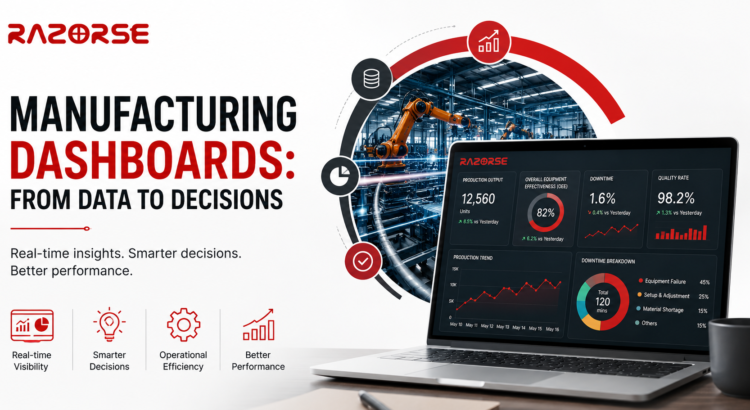
Manufacturing dashboards provide visibility into critical operational KPIs that directly impact productivity and profitability.
One of the most important metrics is Overall Equipment Effectiveness (OEE), which measures machine productivity through availability, performance, and quality analysis. Monitoring OEE helps organizations identify operational inefficiencies quickly.
Downtime tracking is another critical area. Dashboards allow supervisors to monitor planned and unplanned downtime in real time, helping maintenance teams reduce operational disruptions.
Production output tracking helps organizations compare shift performance, monitor production targets, and improve manufacturing efficiency. Similarly, rejection and defect rate monitoring strengthens quality control by identifying production inconsistencies early.
Dashboards also provide visibility into workforce productivity and machine utilization, enabling smarter operational planning and resource optimization.
Benefits of Dashboard-Driven Manufacturing
One of the biggest benefits of manufacturing dashboards is faster decision-making. Leadership teams no longer need to wait for manual reports before responding to operational issues. Instead, they gain instant access to live production insights.
Dashboards also improve operational efficiency by helping organizations identify bottlenecks, recurring downtime patterns, and process inefficiencies quickly. This supports continuous operational improvement.
Another major advantage is improved collaboration across departments. Since all teams access the same operational data, communication becomes more transparent and aligned.
Manufacturing dashboards also support the development of a data-driven organizational culture. Instead of relying solely on assumptions or historical trends, organizations can make decisions based on real-time operational intelligence.
ERP and IoT Integration in Smart Manufacturing
Modern dashboards become even more powerful when integrated with ERP systems and Industrial IoT technologies.
ERP integrations allow organizations to connect operational data with inventory management, procurement planning, workforce allocation, maintenance schedules, and supply chain operations.
Meanwhile, IoT-enabled devices provide real-time machine-level data directly from the shop floor. Sensors can monitor temperature, vibration, performance efficiency, and machine utilization continuously.
Together, ERP systems and IoT technologies create a connected smart manufacturing ecosystem powered by real-time visibility.
Real-World Manufacturing Example
Imagine a manufacturing plant facing repeated production delays due to machine breakdowns and maintenance inefficiencies. In traditional environments, problems may only be identified after major production losses occur.
With real-time dashboards, supervisors receive instant alerts whenever machine performance drops or downtime increases. Maintenance teams can respond immediately, reducing disruptions and improving operational continuity.
This proactive approach improves productivity, reduces costs, and enhances overall equipment reliability.
The Future of Smart Manufacturing
As Industry 4.0 adoption accelerates, manufacturing dashboards are evolving into intelligent decision-support systems powered by AI and analytics.
Modern dashboards can now predict operational trends, identify performance anomalies, recommend corrective actions, and improve production forecasting.
Organizations investing in dashboard-driven operations today are building stronger foundations for smart factory transformation and long-term competitiveness.
Conclusion
Data alone does not create value. The ability to convert operational data into actionable insights is what drives manufacturing excellence.
Manufacturing dashboards help organizations improve visibility, optimize productivity, reduce downtime, and support faster decision-making. As manufacturing environments become more connected and data-driven, dashboards will play a central role in Industry 4.0 transformation.
Looking to build intelligent manufacturing dashboards integrated with ERP and IoT technologies? Connect with Razorse Software to explore smart dashboard solutions designed for modern manufacturing operations.
One thought to “Manufacturing Dashboards: From Data to Decisions”
Comments are closed.