A Simple Guide to Smarter Manufacturing
Imagine this.
Your production line is running smoothly, orders are on track, and everything seems fine.
Then suddenly…
A critical machine stops working.
Production comes to a halt.
Deadlines are missed.
Customers are affected.
And the repair bill? Much higher than expected.
The worst part is that most machine failures don’t happen without warning. They usually show small signs before breaking down. The problem is that these signs often go unnoticed.
This is where Industrial IoT (IIoT) sensors make all the difference.
What Are IoT Sensors?
IoT (Internet of Things) sensors are smart devices installed on machines and equipment. They continuously collect real-time data such as:
- Temperature
- Vibration
- Pressure
- Speed
- Humidity
- Energy consumption
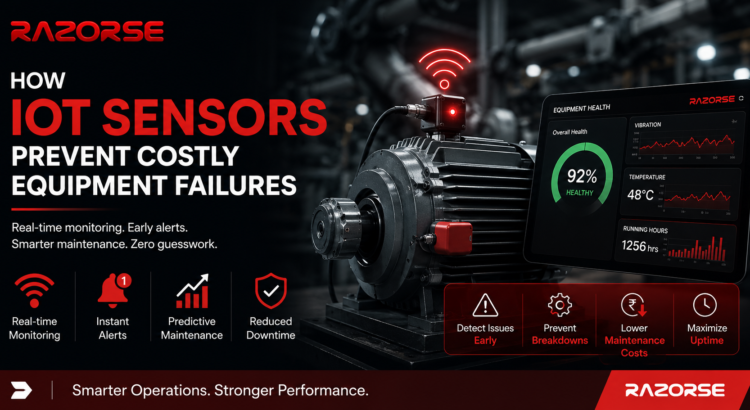
Instead of waiting for a machine to fail, these sensors monitor its health every second and send updates to a centralized dashboard.
Think of them as a fitness tracker for your machines. Just like a smartwatch alerts you when your heart rate is unusually high, IoT sensors alert your maintenance team when a machine starts behaving differently.
Why Equipment Failures Are So Expensive
A machine breakdown doesn’t just mean repair costs.
It can lead to:
- Production delays
- Unplanned downtime
- Higher maintenance expenses
- Missed customer deadlines
- Reduced product quality
- Lower productivity
For manufacturers, even a few hours of downtime can result in significant financial losses.
That’s why preventing failures is always more cost-effective than fixing them.
How IoT Sensors Help Prevent Equipment Failures
1. Early Warning Before Problems Get Bigger
Machines rarely fail overnight.
A motor may begin vibrating more than usual.
A bearing may start heating up.
Power consumption may slowly increase.
These changes might not be visible during regular inspections, but IoT sensors detect them instantly and notify the maintenance team.
This gives businesses enough time to fix the issue before it turns into a costly breakdown.
2. Real-Time Monitoring
Instead of checking machines only during scheduled maintenance, IoT sensors monitor equipment 24/7.
Managers can view the health of every connected machine through a single dashboard.
This real-time visibility helps teams make faster and smarter maintenance decisions.
3. Predictive Maintenance
Traditional maintenance usually follows one of two approaches:
- Repair the machine after it breaks.
- Service it at fixed intervals.
Both approaches have limitations.
With IoT sensors, businesses can move to predictive maintenance.
By analysing sensor data over time, companies can identify patterns that indicate when a component is likely to fail.
This means maintenance is performed only when needed—reducing unnecessary servicing while preventing unexpected failures.
4. Better Resource Planning
When maintenance teams know which machine requires attention and when, they can:
- Schedule repairs in advance
- Order spare parts on time
- Reduce emergency maintenance
- Minimise production disruptions
This improves operational efficiency across the entire facility.
5. Longer Equipment Life
Machines that are monitored regularly experience fewer major failures.
Small issues are resolved before they damage critical components, helping businesses extend the life of expensive equipment and maximise their return on investment.
Industries That Benefit from IoT Sensors
Industrial IoT sensors are useful across many sectors, including:
- Manufacturing
- Automotive
- Food Processing
- Pharmaceuticals
- Warehousing
- Logistics
- Energy
- Heavy Engineering
Any business that depends on machinery can benefit from real-time equipment monitoring.
Why More Businesses Are Choosing Industrial IoT
Modern manufacturing is becoming increasingly data-driven.
Instead of relying on assumptions, businesses now use real-time information to improve performance, reduce downtime, and make informed decisions.
Industrial IoT is no longer just a technology trend—it has become a practical business solution for companies looking to improve efficiency and stay competitive.
The Future Is Proactive, Not Reactive
Waiting for a machine to fail is an expensive strategy.
With Industrial IoT sensors, businesses can detect potential issues early, reduce unplanned downtime, and keep operations running smoothly.
The goal isn’t just to collect data.
It’s to turn that data into timely action.
Companies that embrace smart monitoring today are better prepared for the challenges of tomorrow.
At Razorse, we help businesses leverage Industrial IoT, AI, and Industry 4.0 solutions to build smarter, more connected operations. By combining real-time monitoring with intelligent analytics, organizations can improve productivity, reduce maintenance costs, and make confident, data-driven decisions.