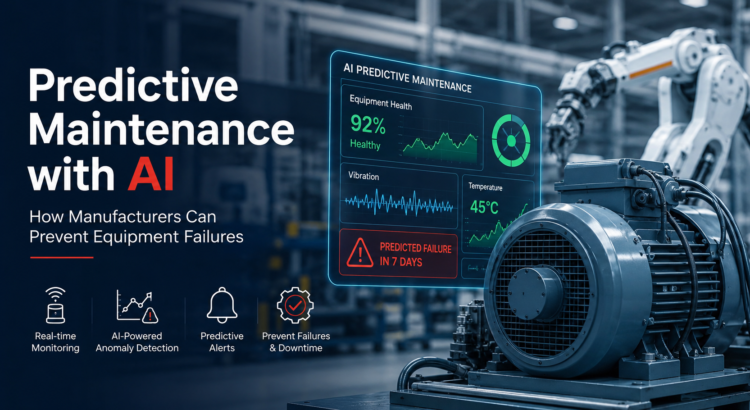
Predictive Maintenance with AI: How Manufacturers Can Prevent Equipment Failures
Manufacturing downtime is expensive. A sudden machine breakdown can disrupt production schedules, increase maintenance costs, delay deliveries, and impact overall operational efficiency. Traditional maintenance approaches such as reactive maintenance and fixed maintenance schedules are no longer enough for modern factories.
This is where AI-powered predictive maintenance is changing the way manufacturers manage equipment.
By combining Artificial Intelligence (AI), Industrial IoT (IIoT), machine learning, and real-time equipment monitoring, manufacturers can identify potential failures before they occur and take corrective action at the right time.
What Is Predictive Maintenance?
Predictive maintenance is a data-driven maintenance strategy that uses equipment data to predict when a machine or component is likely to fail.
Instead of waiting for equipment to break down or servicing machines at predetermined intervals, predictive maintenance continuously monitors machine health and identifies unusual patterns that may indicate an upcoming failure.
AI makes this process more powerful by analyzing large volumes of data from machines, sensors, production systems, and historical maintenance records.
For example, an AI system can detect changes in temperature, vibration, pressure, energy consumption, or operating speed and determine whether these changes indicate normal operation or a potential equipment problem.
How Does AI-Powered Predictive Maintenance Work?
An AI-based predictive maintenance system typically works through four key stages:
1. Real-Time Data Collection
Industrial machines generate huge amounts of operational data. Sensors can monitor parameters such as:
- Temperature
- Vibration
- Pressure
- Motor speed
- Energy consumption
- Noise levels
- Machine operating hours
Using Industrial IoT (IIoT) technologies, this data can be collected continuously from connected equipment.
2. AI and Machine Learning Analysis
The collected data is analyzed using AI and machine learning algorithms.
These algorithms learn from historical machine behavior and maintenance records to identify patterns associated with equipment degradation or failure.
Instead of simply detecting a threshold violation, AI can identify more complex patterns that may not be obvious through manual monitoring.
3. Anomaly Detection
AI-powered systems can identify abnormal machine behavior in real time.
For example, a machine may still be operating within its normal temperature range, but a combination of increasing vibration, rising energy consumption, and changing operating speed could indicate a developing problem.
AI can recognize these patterns and generate an early warning.
4. Predictive Alerts and Maintenance Action
Once the system identifies a potential failure, maintenance teams can receive alerts and insights through an AI dashboard.
This allows engineers to inspect the equipment, schedule maintenance, and replace components before a major breakdown occurs.
The result is a shift from reactive maintenance to proactive, data-driven maintenance.
Key Benefits of Predictive Maintenance in Manufacturing
Reduced Unplanned Downtime
Unexpected equipment failures can bring production lines to a halt. Predictive maintenance helps manufacturers identify potential problems early, reducing the risk of sudden breakdowns and production interruptions.
Lower Maintenance Costs
Traditional preventive maintenance may involve replacing components even when they are still functioning properly. AI-based predictive maintenance enables organizations to perform maintenance based on actual equipment condition, helping optimize maintenance spending.
Improved Equipment Lifespan
Continuous monitoring allows manufacturers to identify abnormal operating conditions before they cause serious damage. Addressing these issues early can help extend the useful life of industrial equipment.
Higher Production Efficiency
Healthy machines operate more consistently. By minimizing unexpected breakdowns and optimizing maintenance schedules, predictive maintenance can contribute to better production efficiency and overall equipment effectiveness.
Better Maintenance Planning
AI-generated insights allow maintenance teams to prioritize equipment that requires attention. Instead of responding to emergencies, teams can plan maintenance activities around production schedules.
AI Predictive Maintenance vs Traditional Maintenance
Traditional maintenance strategies generally fall into two categories: reactive maintenance, where equipment is repaired after failure, and preventive maintenance, where equipment is serviced according to a fixed schedule.
Predictive maintenance takes a different approach.
It uses real-time machine data, historical information, AI analytics, and machine learning to determine when maintenance may actually be required.
This makes maintenance more condition-based and data-driven.
The Role of AI Dashboards in Predictive Maintenance
An AI-powered maintenance dashboard can bring equipment health data into a single interface.
Maintenance managers can monitor machine conditions, identify anomalies, view predictive alerts, analyze historical trends, and prioritize maintenance activities.
This provides decision-makers with a clearer view of factory operations and helps transform complex machine data into actionable insights.
The Future of Predictive Maintenance
As manufacturing becomes increasingly connected, predictive maintenance is expected to become an important component of Industry 4.0 and smart manufacturing.
The combination of AI, IIoT, edge computing, computer vision, and advanced analytics can enable factories to move toward increasingly autonomous equipment monitoring and maintenance.
The future is not simply about detecting when a machine is likely to fail. It is about understanding why the failure may happen, what action should be taken, and how production can be optimized around it.
Conclusion
AI-powered predictive maintenance is helping manufacturers move from reactive equipment management to intelligent, proactive operations.
By continuously analyzing machine data, detecting anomalies, predicting potential failures, and providing actionable insights, AI can help organizations reduce downtime, optimize maintenance costs, improve equipment reliability, and increase operational efficiency.
For manufacturers looking to build smarter and more resilient operations, predictive maintenance is no longer just a future concept—it is becoming a key part of the Industry 4.0 transformation.
Ready to Make Your Manufacturing Operations Smarter?
Razorse helps businesses explore AI, Industrial IoT, automation, and Industry 4.0 solutions designed to improve operational visibility and efficiency.
Connect with Razorse to explore how AI-powered predictive maintenance can transform your manufacturing operations.