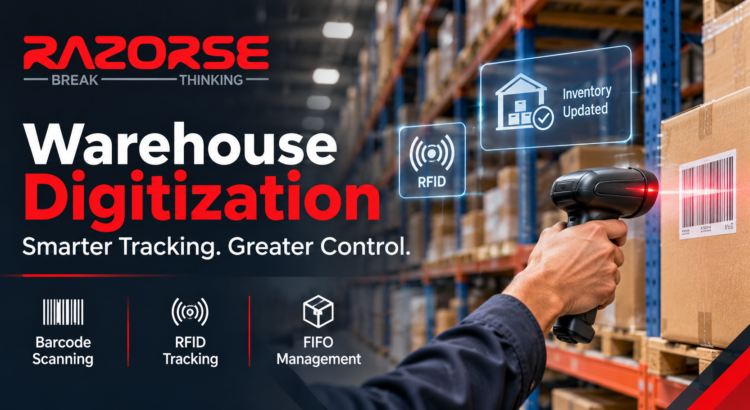
Warehouses digitization play an important role in manufacturing, retail and supply chain operations. Every day, businesses receive, store, move and dispatch large amounts of materials and products. Managing all this manually can become difficult, especially when inventory levels change frequently.
Imagine spending valuable time searching for a product, checking stock records or trying to find out where a particular item was moved. These small challenges can slow down daily operations and lead to mistakes.
This is where Warehouse Digitization comes in.
Warehouse digitization uses modern technologies such as barcode scanning, RFID tracking and digital inventory management to make warehouse operations faster, more accurate and easier to manage. It helps businesses keep track of their stock, monitor material movement and improve overall efficiency.
Let’s understand how it works and why it matters.
What Is Warehouse Digitization?
Warehouse digitization means replacing traditional manual processes with digital systems and technologies.
Instead of depending only on paper registers, spreadsheets and manual stock updates, businesses use digital tools to record and monitor inventory information.
For example, when a product enters a warehouse, its details can be recorded using a barcode or RFID tag. When the product moves from one location to another, the system can update its movement records.
This makes it easier for warehouse teams to know:
- What materials are available in stock.
- Where each item is stored.
- How much inventory has been received or dispatched.
- Which products need replenishment.
- Which stock should be used first.
In simple terms, warehouse digitization gives businesses better visibility and control over their inventory.
1. Barcode Scanning: Making Inventory Tracking Easier
Barcode scanning is one of the most common technologies used in modern warehouses.
A barcode contains information about a product or material. Using a barcode scanner, warehouse employees can quickly read this information and update the inventory system.
For example, when new materials arrive, employees can scan their barcodes instead of entering product details manually. The same process can be followed during storage, picking and dispatch.
How does barcode scanning help?
- Reduces manual data entry.
- Improves inventory accuracy.
- Speeds up receiving and dispatch processes.
- Makes product identification easier.
- Helps maintain organised stock records.
By reducing repetitive manual work, barcode technology allows warehouse teams to focus more on their daily operations.
2. RFID Technology: Better Visibility of Stock Movement
RFID stands for Radio Frequency Identification. It uses radio waves to identify and track items through RFID tags and readers.
Unlike traditional barcode systems, RFID technology does not always require direct line-of-sight scanning. Depending on the system and setup, multiple tagged items can also be identified within a reader’s range.
For warehouses handling large volumes of materials, this can make inventory tracking more convenient.
Key benefits of RFID tracking include:
- Faster identification of tagged items.
- Better visibility of stock movement.
- Improved material traceability.
- Reduced dependence on manual scanning.
- Easier monitoring of inventory across different locations.
For businesses looking to improve warehouse operations, RFID can be a useful step towards smarter inventory management.
3. Digital Stock Movement: Know Where Your Inventory Goes
Knowing how much stock is available is important, but knowing where it is moving is equally important.
In a warehouse, materials move through several stages, including receiving, inspection, storage, picking and dispatch.
When these movements are recorded manually, information can sometimes become outdated or difficult to track.
Digital stock movement systems help record these activities and maintain a better history of inventory transactions.
This allows businesses to understand where materials are stored, when they were moved and how much stock has been issued or received.
Better stock visibility also helps reduce unnecessary searching, misplaced inventory and delays in warehouse operations.
4. FIFO Management: Using Older Stock First
FIFO stands for First In, First Out. It is an inventory management method in which the materials received first are used or dispatched first.
For example, if a warehouse receives a batch of materials on Monday and another batch on Friday, the Monday batch should generally be used first.
This approach is particularly useful for products with expiry dates, limited shelf life or materials that may lose quality over time.
Digital FIFO management helps warehouse teams identify older stock and follow the correct usage sequence.
Why is FIFO important?
- Reduces the chances of stock ageing.
- Helps minimise material wastage.
- Supports better inventory rotation.
- Improves stock management.
- Helps maintain product quality.
When FIFO is combined with digital inventory tracking, businesses can manage stock rotation more effectively.
5. Why Should Businesses Invest in Warehouse Digitization?
Warehouse digitization is not just about adopting new technology. It is about making everyday operations simpler and more organised.
Here are some important benefits:
Improved Inventory Accuracy: Digital records help reduce errors caused by manual stock entries and repeated data handling.
Faster Warehouse Operations: Barcode and RFID systems can make product identification and inventory updates quicker.
Better Traceability: Businesses can maintain clearer records of material movement, making it easier to track inventory.
Reduced Manual Work: Automated data capture reduces repetitive tasks and allows employees to focus on other important activities.
Better Decision-Making: Updated inventory information helps managers plan stock requirements, replenishment and dispatch more effectively.
Together, these improvements can support better warehouse performance and more efficient supply chain operations.
How Razorse Supports Smarter Warehouse Operations
As businesses move towards digital transformation, having better control over warehouse activities is becoming increasingly important.
Razorse believes that smarter operations begin with better visibility, accurate information and connected processes.
Warehouse digitization brings together technologies such as barcode scanning, RFID tracking, digital inventory management and FIFO practices to help businesses improve the way they manage stock and material movement.
The goal is simple: reduce unnecessary manual effort, improve inventory visibility and make warehouse operations more efficient.
Conclusion
A warehouse is more than just a place to store materials. It is an important part of the entire supply chain.
When inventory records are inaccurate or stock movement is difficult to track, it can affect business operations at multiple levels.
Warehouse digitization helps businesses move from manual tracking to smarter, more organised inventory management.
With technologies like barcode scanning, RFID and digital FIFO management, businesses can build better visibility, improve traceability and manage their warehouse operations with greater confidence.
The future of warehousing is not just about storing more stock. It is about managing it smarter.
Ready to rethink your warehouse operations?
Explore smarter digital solutions with Razorse.
Website: www.razorse.com
Email: info@razorse.com