24/7 Support : info@razorse.com | WhatsApp : +91-7011221090

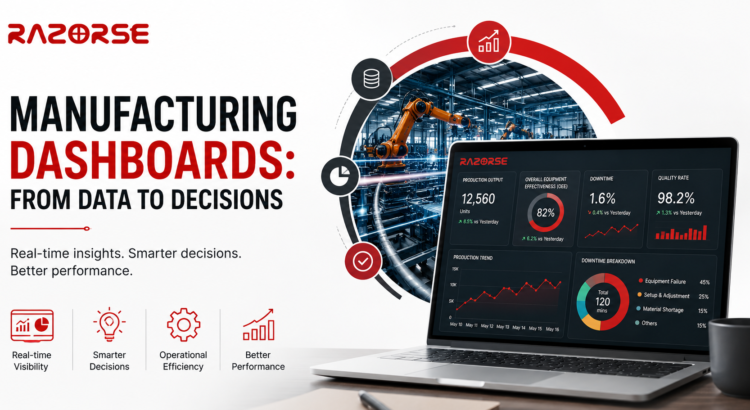
Real-time manufacturing dashboard for monitoring production, quality, and operational performance by Razorse.

Manufacturing Dashboards: From Data to Decisions

Introduction

Modern manufacturing plants generate massive volumes of operational data every day. Machines produce performance metrics, production lines generate output data, maintenance teams track downtime, and ERP systems manage inventory, procurement, and workforce operations. Despite having access to this information, many organizations still struggle to convert data into actionable business insights.

This is where manufacturing dashboards are transforming industrial operations.

Real-time dashboards help manufacturing organizations centralize critical operational data into a single visual interface, enabling faster decisions, improved productivity, and greater operational visibility. In today’s Industry 4.0 environment, dashboard-driven manufacturing is becoming a key driver of smart factory transformation.

The Problem with Data Silos

Many manufacturing plants still operate using disconnected systems across departments. Production teams, maintenance departments, HR units, and inventory managers often rely on separate software systems or spreadsheets that do not communicate efficiently with one another.

This creates major operational challenges. Leadership teams spend significant time manually collecting reports before making decisions. By the time the data is reviewed, it may already be outdated.

Without real-time visibility, organizations struggle to identify production bottlenecks, downtime causes, quality issues, and operational inefficiencies quickly.

Why Real-Time Manufacturing Dashboards Matter

Manufacturing dashboards eliminate fragmented reporting structures by centralizing operational data into one platform. Instead of waiting for end-of-day reports, plant managers can monitor live operational performance in real time.

This enables organizations to respond faster to production issues, improve machine utilization, reduce downtime, optimize workforce allocation, improve production planning, and enhance quality control.

Real-time visibility allows organizations to shift from reactive operations to proactive decision-making.

Key Metrics Every Plant Should Monitor

Manufacturing dashboards provide visibility into critical operational KPIs that directly impact productivity and profitability.

One of the most important metrics is Overall Equipment Effectiveness (OEE), which measures machine productivity through availability, performance, and quality analysis. Monitoring OEE helps organizations identify operational inefficiencies quickly.

Downtime tracking is another critical area. Dashboards allow supervisors to monitor planned and unplanned downtime in real time, helping maintenance teams reduce operational disruptions.

Production output tracking helps organizations compare shift performance, monitor production targets, and improve manufacturing efficiency. Similarly, rejection and defect rate monitoring strengthens quality control by identifying production inconsistencies early.

Dashboards also provide visibility into workforce productivity and machine utilization, enabling smarter operational planning and resource optimization.

Benefits of Dashboard-Driven Manufacturing

One of the biggest benefits of manufacturing dashboards is faster decision-making. Leadership teams no longer need to wait for manual reports before responding to operational issues. Instead, they gain instant access to live production insights.

Dashboards also improve operational efficiency by helping organizations identify bottlenecks, recurring downtime patterns, and process inefficiencies quickly. This supports continuous operational improvement.

Another major advantage is improved collaboration across departments. Since all teams access the same operational data, communication becomes more transparent and aligned.

Manufacturing dashboards also support the development of a data-driven organizational culture. Instead of relying solely on assumptions or historical trends, organizations can make decisions based on real-time operational intelligence.

ERP and IoT Integration in Smart Manufacturing

Modern dashboards become even more powerful when integrated with ERP systems and Industrial IoT technologies.

ERP integrations allow organizations to connect operational data with inventory management, procurement planning, workforce allocation, maintenance schedules, and supply chain operations.

Meanwhile, IoT-enabled devices provide real-time machine-level data directly from the shop floor. Sensors can monitor temperature, vibration, performance efficiency, and machine utilization continuously.

Together, ERP systems and IoT technologies create a connected smart manufacturing ecosystem powered by real-time visibility.

Real-World Manufacturing Example

Imagine a manufacturing plant facing repeated production delays due to machine breakdowns and maintenance inefficiencies. In traditional environments, problems may only be identified after major production losses occur.

With real-time dashboards, supervisors receive instant alerts whenever machine performance drops or downtime increases. Maintenance teams can respond immediately, reducing disruptions and improving operational continuity.

This proactive approach improves productivity, reduces costs, and enhances overall equipment reliability.

The Future of Smart Manufacturing

As Industry 4.0 adoption accelerates, manufacturing dashboards are evolving into intelligent decision-support systems powered by AI and analytics.

Modern dashboards can now predict operational trends, identify performance anomalies, recommend corrective actions, and improve production forecasting.

Organizations investing in dashboard-driven operations today are building stronger foundations for smart factory transformation and long-term competitiveness.

Conclusion

Data alone does not create value. The ability to convert operational data into actionable insights is what drives manufacturing excellence.

Manufacturing dashboards help organizations improve visibility, optimize productivity, reduce downtime, and support faster decision-making. As manufacturing environments become more connected and data-driven, dashboards will play a central role in Industry 4.0 transformation.

Looking to build intelligent manufacturing dashboards integrated with ERP and IoT technologies? Connect with Razorse Software to explore smart dashboard solutions designed for modern manufacturing operations.
What is Industry 4.0? A Complete Guide for Indian Manufacturers (2026 Edition)

Introduction
The manufacturing landscape in India is undergoing a significant transformation. With rising global competition, increasing operational costs, and growing demand for efficiency and quality, traditional manufacturing models are no longer sufficient. Companies that continue to rely on outdated processes risk losing their competitive edge in an increasingly digital world.

This shift has led to the emergence of Industry 4.0, often referred to as the fourth industrial revolution. It represents a new era where advanced technologies are integrated into manufacturing processes to create smarter, more efficient, and highly connected operations.

For Indian manufacturers—especially SMEs—Industry 4.0 is not just a trend but a necessity for long-term growth and sustainability.

Challenges in Traditional Manufacturing
Despite technological advancements, many manufacturing units in India still operate using conventional methods. These include manual data entry, disconnected systems, and limited real-time visibility into operations.

Such limitations create several challenges. Machine breakdowns often occur without warning, leading to unplanned downtime and production delays. Workforce management becomes inefficient due to a lack of visibility into employee skills and performance. Decision-making is often delayed because data is either unavailable or outdated.

As businesses scale, these inefficiencies multiply, resulting in higher operational costs, inconsistent product quality, and reduced profitability. Without adopting digital solutions, it becomes difficult for manufacturers to remain competitive in both domestic and global markets.

What is Industry 4.0?
Industry 4.0 refers to the digital transformation of manufacturing, where machines, systems, and people are interconnected through advanced technologies. It enables seamless communication between different components of the production ecosystem, allowing for real-time data exchange and intelligent decision-making.

At its core, Industry 4.0 combines several key technologies. The Internet of Things (IoT) connects machines and devices through sensors, enabling real-time data collection. Artificial Intelligence (AI) and machine learning analyze this data to generate insights and predictions. Cloud computing provides centralized access to information, while advanced analytics helps organizations optimize processes and improve efficiency.

Together, these technologies create a smart manufacturing environment that is adaptive, efficient, and data-driven.

Smart Factory vs Traditional Factory
In a traditional factory setup, operations are largely manual and reactive. Data is collected periodically, often on paper or spreadsheets, and decisions are made based on past performance. Maintenance activities are typically carried out only after a machine fails, leading to costly downtime and disruptions.

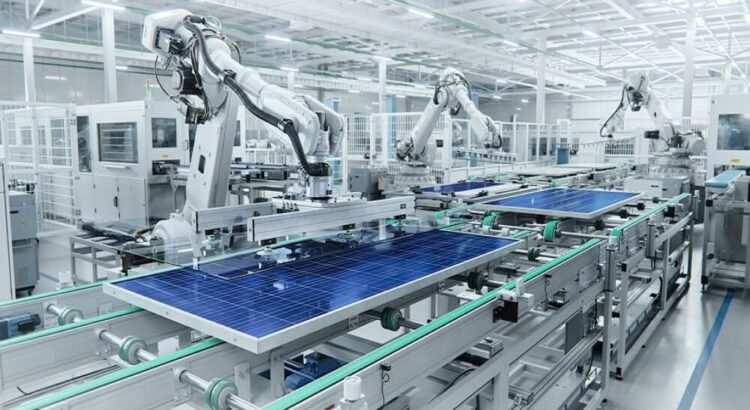
In contrast, a smart factory operates on real-time data and automation. Machines are connected through sensors that continuously monitor performance. Maintenance becomes predictive, meaning potential issues are identified and resolved before they lead to breakdowns. Workforce management is digitized, allowing managers to track skills, productivity, and training needs efficiently.

Most importantly, decision-making in a smart factory is fast, accurate, and data-driven. This results in higher productivity, improved quality, and significant cost savings.

Key Benefits of Industry 4.0
Adopting Industry 4.0 offers several tangible benefits for manufacturers. One of the most significant advantages is increased productivity. Automation and real-time monitoring allow companies to optimize their operations and reduce inefficiencies.

Another major benefit is reduced downtime. With predictive maintenance systems in place, machines are monitored continuously, and potential failures are addressed before they occur. This ensures smoother production cycles and minimizes disruptions.

Quality improvement is another critical outcome. Real-time inspection and monitoring systems help detect defects early, ensuring consistent product quality. Additionally, better data visibility enables faster and more informed decision-making.

Cost optimization is also a key advantage. By reducing waste, improving resource utilization, and minimizing downtime, manufacturers can significantly lower their operational expenses.

Practical Use Cases in Manufacturing
Industry 4.0 is not just a concept—it is already being implemented across various manufacturing sectors.

One common use case is predictive maintenance, where AI analyzes machine data to predict failures in advance. Another is real-time production monitoring, where dashboards provide instant insights into plant performance.

Digital workforce management is also gaining importance. By tracking employee skills and performance digitally, manufacturers can ensure optimal workforce utilization. Additionally, AI-powered quality inspection systems are being used to detect defects with greater accuracy than manual processes.

These applications demonstrate how Industry 4.0 can deliver measurable improvements in efficiency and performance.

How Razorse Enables Industry 4.0
Razorse Software plays a crucial role in helping manufacturers adopt Industry 4.0 solutions. With a strong focus on innovation and practical implementation, Razorse offers a range of technologies designed to drive digital transformation.

One of the key offerings is DOJO 2.0, a workforce management platform that enables real-time skill tracking and productivity improvement. In addition, Razorse provides AI-driven analytics for predictive maintenance and decision-making.

The company also specializes in ERP integrations, ensuring seamless data flow across systems, and VR-based training solutions that enhance workforce safety and skill development. Together, these solutions help manufacturers transition smoothly into smart, connected operations.

Conclusion
Industry 4.0 is redefining the future of manufacturing. For Indian manufacturers, adopting digital technologies is no longer optional—it is essential for staying competitive in a rapidly evolving market.

Organizations that embrace Industry 4.0 today will be better equipped to improve efficiency, reduce costs, and scale their operations effectively. Those that delay adoption risk being left behind.CTA
Ready to transform your manufacturing operations?
Get in touch with Razorse Software for a personalized Industry 4.0 consultation and take the first step toward building a smart factory.