How API-Driven Healthcare Platforms Improve Data Connectivity
Healthcare is becoming increasingly digital, but one major challenge continues to slow down transformation: API-Driven data connectivity.
Hospitals, clinics, diagnostic laboratories, pharmacies, insurance providers, and healthcare applications often rely on different software systems. When these systems cannot communicate effectively, healthcare data becomes fragmented, making it harder for organizations to access the right information at the right time.
This is where API-driven healthcare platforms can make a significant difference.
By enabling different applications and systems to securely exchange data, APIs can create a more connected healthcare ecosystem, improve interoperability, and help organizations build scalable digital healthcare solutions.
What Is an API-Driven Healthcare Platform?
An API, or Application Programming Interface, allows different software applications to communicate with each other.
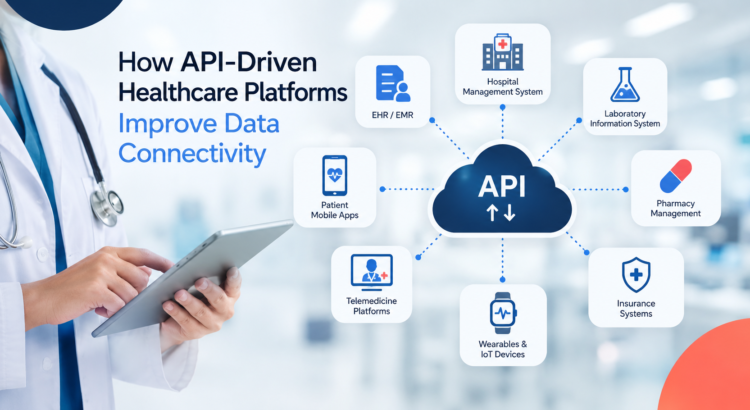
In healthcare, APIs can connect systems such as:
- Electronic Health Records (EHR)
- Electronic Medical Records (EMR)
- Hospital Management Systems
- Laboratory Information Systems
- Pharmacy Management Software
- Healthcare mobile applications
- Telemedicine platforms
- Insurance systems
- Medical devices and IoT platforms
Instead of keeping healthcare information isolated within individual systems, an API-driven healthcare platform creates a framework through which authorized systems can securely exchange relevant information.
This makes APIs an important part of healthcare software development and digital transformation.
Why API-Driven Data Connectivity Matters in Healthcare
Healthcare generates enormous amounts of data every day. Patient information, laboratory results, prescriptions, medical histories, appointments, billing records, and diagnostic information may all exist across different platforms.
Without effective connectivity, organizations can face:
- Data silos
- Duplicate data entry
- Delayed access to information
- Manual processes
- Inconsistent patient records
- Integration challenges
- Poor coordination between departments
For healthcare providers, these challenges can affect operational efficiency and the overall digital experience for patients and healthcare professionals.
Healthcare interoperability helps address this problem by allowing different systems to exchange and understand information more effectively.
1. Connecting Multiple Healthcare Systems
One of the biggest advantages of API-driven architecture is its ability to connect different healthcare applications.
For example, a hospital may use separate systems for patient management, diagnostics, pharmacy operations, billing, and appointments.
APIs can act as the communication layer between these systems, allowing relevant information to move between applications without requiring organizations to completely replace their existing infrastructure.
This makes healthcare system integration more practical and scalable.
2. Improving Healthcare Interoperability
Interoperability is becoming increasingly important as healthcare organizations adopt more digital technologies.
An interoperable healthcare environment allows different systems to exchange information in a structured and meaningful way.
Modern healthcare APIs can support integration with standards and frameworks such as HL7 and FHIR, helping healthcare applications communicate more consistently.
For organizations building modern healthcare platforms, following appropriate interoperability standards can make it easier to connect with existing systems and future technologies.
3. Reducing Manual Data Entry
Manual data entry is time-consuming and can introduce avoidable errors.
Consider a patient’s diagnostic report being generated in a laboratory system and then manually entered into another healthcare application.
With appropriate API integration, information can move automatically between connected systems based on defined workflows and permissions.
This can help reduce repetitive administrative work while allowing healthcare professionals to spend more time on higher-value tasks.
4. Enabling Real-Time Data Exchange
Healthcare decisions often depend on timely information.
API-based systems can facilitate near-real-time exchange of relevant information between connected applications.
For example, when a patient’s information is updated in one authorized system, another connected application can retrieve the latest available information through an API.
This can support faster workflows across hospitals, clinics, laboratories, pharmacies, and other healthcare environments.
5. Supporting Telemedicine and Digital Health
The growth of telemedicine and digital health applications has increased the need for reliable healthcare data integration.
A telemedicine platform may need to interact with patient records, appointment systems, payment platforms, diagnostic services, and other applications.
An API-first healthcare architecture can make these integrations easier to develop and maintain.
This allows businesses to build digital healthcare solutions that can connect with existing infrastructure rather than operating as isolated applications.
6. Making Healthcare Platforms More Scalable
Healthcare organizations are continuously adopting new technologies.
A platform that works today may need to integrate with new applications, devices, AI solutions, or third-party services tomorrow.
This is where scalable healthcare software architecture becomes important.
With an API-driven approach, organizations can add or modify integrations without necessarily rebuilding the entire application.
This flexibility can help businesses develop healthcare platforms that are better prepared for evolving technology requirements.
7. Connecting Healthcare With AI and IoT
The future of healthcare is not limited to traditional software systems.
AI, machine learning, wearable devices, remote monitoring systems, and healthcare IoT are generating new sources of healthcare data.
APIs can provide the connectivity layer needed to bring these technologies into existing digital ecosystems.
For example, an API-enabled platform could potentially connect data from authorized wearable or monitoring devices with healthcare applications, allowing relevant information to be accessed and analyzed within connected workflows.
Combined with AI in healthcare, this connectivity can open opportunities for predictive analytics, automation, personalized services, and more intelligent decision-making.
Security and Privacy Are Critical
Healthcare data is highly sensitive, which means connectivity cannot come at the expense of security.
A robust healthcare API integration strategy should consider authentication, authorization, encryption, access controls, monitoring, and regulatory requirements from the beginning.
Organizations should also ensure that users and systems can access only the information they are authorized to access.
Security should therefore be treated as a core component of healthcare software architecture not something added after integration is complete.
The Future of API-Driven Healthcare
Healthcare is moving toward a more connected digital ecosystem.
As hospitals, clinics, diagnostic centers, insurers, health-tech companies, and patients increasingly rely on digital platforms, the ability to securely exchange information will become even more important.
API-driven healthcare platforms provide the foundation for connecting applications, improving interoperability, supporting digital health services, and integrating emerging technologies such as AI and IoT.
For organizations planning a digital transformation initiative, the objective should not simply be to connect two applications. It should be to build a scalable, secure, and interoperable healthcare technology ecosystem that can adapt as the organization grows.
With the right architecture and integration strategy, APIs can turn disconnected healthcare systems into a more connected digital infrastructure.