24/7 Support : info@razorse.com | WhatsApp : +91-7011221090

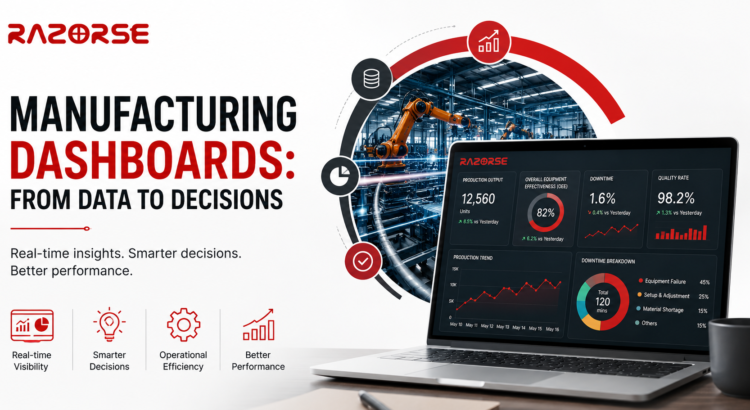
Real-time manufacturing dashboard for monitoring production, quality, and operational performance by Razorse.

Manufacturing Dashboards: From Data to Decisions

Introduction

Modern manufacturing plants generate massive volumes of operational data every day. Machines produce performance metrics, production lines generate output data, maintenance teams track downtime, and ERP systems manage inventory, procurement, and workforce operations. Despite having access to this information, many organizations still struggle to convert data into actionable business insights.

This is where manufacturing dashboards are transforming industrial operations.

Real-time dashboards help manufacturing organizations centralize critical operational data into a single visual interface, enabling faster decisions, improved productivity, and greater operational visibility. In today’s Industry 4.0 environment, dashboard-driven manufacturing is becoming a key driver of smart factory transformation.

The Problem with Data Silos

Many manufacturing plants still operate using disconnected systems across departments. Production teams, maintenance departments, HR units, and inventory managers often rely on separate software systems or spreadsheets that do not communicate efficiently with one another.

This creates major operational challenges. Leadership teams spend significant time manually collecting reports before making decisions. By the time the data is reviewed, it may already be outdated.

Without real-time visibility, organizations struggle to identify production bottlenecks, downtime causes, quality issues, and operational inefficiencies quickly.

Why Real-Time Manufacturing Dashboards Matter

Manufacturing dashboards eliminate fragmented reporting structures by centralizing operational data into one platform. Instead of waiting for end-of-day reports, plant managers can monitor live operational performance in real time.

This enables organizations to respond faster to production issues, improve machine utilization, reduce downtime, optimize workforce allocation, improve production planning, and enhance quality control.

Real-time visibility allows organizations to shift from reactive operations to proactive decision-making.

Key Metrics Every Plant Should Monitor

Manufacturing dashboards provide visibility into critical operational KPIs that directly impact productivity and profitability.

One of the most important metrics is Overall Equipment Effectiveness (OEE), which measures machine productivity through availability, performance, and quality analysis. Monitoring OEE helps organizations identify operational inefficiencies quickly.

Downtime tracking is another critical area. Dashboards allow supervisors to monitor planned and unplanned downtime in real time, helping maintenance teams reduce operational disruptions.

Production output tracking helps organizations compare shift performance, monitor production targets, and improve manufacturing efficiency. Similarly, rejection and defect rate monitoring strengthens quality control by identifying production inconsistencies early.

Dashboards also provide visibility into workforce productivity and machine utilization, enabling smarter operational planning and resource optimization.

Benefits of Dashboard-Driven Manufacturing

One of the biggest benefits of manufacturing dashboards is faster decision-making. Leadership teams no longer need to wait for manual reports before responding to operational issues. Instead, they gain instant access to live production insights.

Dashboards also improve operational efficiency by helping organizations identify bottlenecks, recurring downtime patterns, and process inefficiencies quickly. This supports continuous operational improvement.

Another major advantage is improved collaboration across departments. Since all teams access the same operational data, communication becomes more transparent and aligned.

Manufacturing dashboards also support the development of a data-driven organizational culture. Instead of relying solely on assumptions or historical trends, organizations can make decisions based on real-time operational intelligence.

ERP and IoT Integration in Smart Manufacturing

Modern dashboards become even more powerful when integrated with ERP systems and Industrial IoT technologies.

ERP integrations allow organizations to connect operational data with inventory management, procurement planning, workforce allocation, maintenance schedules, and supply chain operations.

Meanwhile, IoT-enabled devices provide real-time machine-level data directly from the shop floor. Sensors can monitor temperature, vibration, performance efficiency, and machine utilization continuously.

Together, ERP systems and IoT technologies create a connected smart manufacturing ecosystem powered by real-time visibility.

Real-World Manufacturing Example

Imagine a manufacturing plant facing repeated production delays due to machine breakdowns and maintenance inefficiencies. In traditional environments, problems may only be identified after major production losses occur.

With real-time dashboards, supervisors receive instant alerts whenever machine performance drops or downtime increases. Maintenance teams can respond immediately, reducing disruptions and improving operational continuity.

This proactive approach improves productivity, reduces costs, and enhances overall equipment reliability.

The Future of Smart Manufacturing

As Industry 4.0 adoption accelerates, manufacturing dashboards are evolving into intelligent decision-support systems powered by AI and analytics.

Modern dashboards can now predict operational trends, identify performance anomalies, recommend corrective actions, and improve production forecasting.

Organizations investing in dashboard-driven operations today are building stronger foundations for smart factory transformation and long-term competitiveness.

Conclusion

Data alone does not create value. The ability to convert operational data into actionable insights is what drives manufacturing excellence.

Manufacturing dashboards help organizations improve visibility, optimize productivity, reduce downtime, and support faster decision-making. As manufacturing environments become more connected and data-driven, dashboards will play a central role in Industry 4.0 transformation.

Looking to build intelligent manufacturing dashboards integrated with ERP and IoT technologies? Connect with Razorse Software to explore smart dashboard solutions designed for modern manufacturing operations.
Predictions about the Software Development trends in 2022

Predictions about the Software Development trends in 2022

After the tragic, pandemic-hit 2020, 2021 was the year of resiliency and fight-back for humanity. Because ofhigh-techinnovations, countries were able to vaccinate people all together. For the IT industry &Software Development, 2021 was animportant year as anticipated.

For the Software Development industry, the present digitalization trends will continue with a lot of changes, innovations, and new uses of present technologies. To predict the future is a challenging task. Here are the most important trends of Software Development trends in 2022.

1. Centralized Infrastructure: Cloud-First is the new normal – The public Cloud will continue to substitute the regional Data Center. In the upcoming years, the public Cloud will be the go-to Infrastructure for Enterprises, Startups &Government. The public Cloud is now the source of digital invention, and the trend would continue in 2022. Public Cloud is playing an important role in democratizing Security, Blockchain as well as bringing several innovations in a reachable way to the customer.

2. Decentralized Infrastructure: Cloud on the Edge – Unlike the public Cloud where we need to have the storage, compute power& AI/ML in a central place (Availability Zone, Region); Edge computing gets the storage, compute power and AI/ML near the client. With the upswing of 5G, Web 3.0, and other high-tech innovations, edge computing would continue to see widespread acceptance in 2022 and beyond. Moreover, retailers will accept edge computing hugely in the coming years.

3. Cyber Security: Cyber Security is just like “Elephant in the Room” for startups or the mid-size companies. They can see the necessity for Cyber Security however cannot implement it correctly because of a lack of resources. Only big enterprises can afford a specialized safety team. One of the most important benefits of the public cloud sellers is that they have democratized Cyber Security. Nowadays, leveraging the Public Cloud services, Startups & mid-size companies can implement highly secure apps without too much effort.

4. Blockchain: Blockchain (Distributed Ledger) is amongst the most disruptive skill in the 21st Century. Cryptocurrency is its most recognized use case, however Blockchain is a lot more than just Cryptocurrency. It can change several fields of our industry as well as affect our daily lives.

5. Machine Learning: Machine Learning (ML) is one more disruptive technology with great success and acceptance in current years. Though, according to its demand, there is a huge shortage of Machine Learning specialists. Also, several companies want to adopt machine learning in a restricted way without hiring a full-time, overpriced machine learning professional.

6. Real-Time Streaming: In Real-Time streaming, Apache Flink is the market leader without any question. It even supports Apache Beam API and provides vendor-neutral solutions to manage real-time streaming data.

7. Rapid Application Development: The Low Code/No Code (LCNC) initiative meant to lower the barrier to develop Web/Mobile apps without a developer (or less number of developers). We still need developers to create applications in years to come. However there are also several cases where Low Code/No Code frameworks/tools can considerably expedite the Application development.

8. Programming (mainstream): Python leads the way – In recent years, there has been a fast rise of Python as a common-purpose programming language. Python took the lead and is the number one programming language now.

9. Programming (enterprise): Java hits back – For the longest time, Java was undeniably the number one programming language. It is moderately complex, interpreted, garbage-collected, multi-threaded, and a powerful programming language. Furthermore, JVM is battle-tested, dominant, mature, and the best Process Virtual Machines in the business. Java was perfect for large enterprise applications.

10. Client-Side Web Frameworks: React & Angular for enterprises – In current Web app development, JavaScript/TypeScript based frameworks directs/rules and the trend will continue in 2022. There are several JavaScript/TypeScript based web frameworks, however two frameworks stand out from rest. One is React from Facebook and the other is Angular (Angular 2+) from Google.

11. Server-Side Frameworks (Java): Spring MVC/Spring Boot is the foremost Server-Side framework in Java.

The Best Manufacturing Software for Your Small Business

The Best Manufacturing Software for Your Small Business

Discovering the right manufacturing software for a small business is important to productivity and success for several reasons. It can assist you transform your supply chain by providing automation, visibility and control as never before, aiding you swiftly scale your brand and enhance your existing systems without a massiveexpend. Certainly, your business could value from an ERP (enterprise resource planning) software, which can help you simplify many aspects of your company in a single program.

Investing in an Enterprise Resource Planning (ERP) software can assist organizations bring together distinct activities under a solo integrated application, thus streamlining processes and growing agility.  Multi-faceted ERP software use a unified database that significantly speeds up the response time to clients, increases operative efficiency and guarantees customer success.

Reasons to switch to an ERP Software:

It streamlines and simplifies – Offering an actual view of all your major processes under one system, an ERP platform simplifies &streamlines many of your company’s tasks. For many companies, this means rationalizing from various software solutions to a single one that keeps all your main functions under one roof. It also generates a central, company-wide hub that needs only one software training for all the departments.

It delivers Real-Time Data – Analytics are significant to any business that want to adapt to the ever-changing requirements of the customer and the industry. One best thing about a good ERP is that it tracks data through several departments that you perhaps now treat as distinct entities, providing you with detailed analytics in order that you can tweak as required to get the best possible result.

It boosts customer service – One important thing that many small businesses notice when starting with an ERP is precision and accuracy. Since you have thorough visibility of inventory, supplies, development, planning, shipping and more, there is a much lower risk of mistake and dissatisfied customers. The right ERP software can offer you with exact, automated order tracking for a pleased consumer base, along with accurate inventory updates.

It decreases costs – An appropriate ERP can save you money by decreasing error, keeping clients happy, stopping inventory excess or deficit, tracking expenditures and write-offs and decreasing operational expenses by automating and checking all of the company’s finances.

It helps nurture your business – Towards the end, growing companies requires more of everything, comprising labor, warehouse, time, space and marketing. Many manufacturing software solutions work a lot to augment what you already have and add space for more. For instance, the right ERP could support you take benefit of your warehouse space with the purpose to store more goods without having to spread your facility’s footmark or capitalize in more storage. In brief, they are all planned for mounting and scaling businesses.