24/7 Support : info@razorse.com | WhatsApp : +91-7011221090

Agentic AI

Agentic AI in 2026: From AI Assistants to Autonomous Workflows

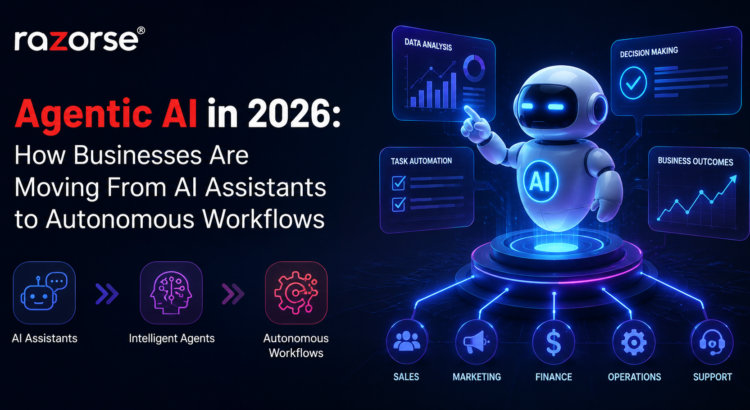
Agentic AI in 2026: How Businesses Are Moving From AI Assistants to Autonomous Workflows

Artificial intelligence has moved far beyond chatbots and basic AI assistants. In 2026, businesses are increasingly adopting Agentic AI—AI systems that can understand goals, make decisions, use digital tools, and execute multi-step tasks with limited human intervention.

While traditional AI assistants primarily respond to prompts, AI agents are designed to take action. This shift is changing how organizations approach automation, productivity, customer experience, software development, operations, and decision-making.

What Is Agentic AI?

Agentic AI refers to AI systems capable of operating toward a defined objective rather than simply generating a response. An AI agent can analyze information, create a plan, interact with applications, execute tasks, evaluate results, and adjust its approach when necessary.

For example, a traditional AI assistant might help a sales executive write a follow-up email. An AI agent for sales automation could identify leads from a CRM, analyze previous interactions, prioritize prospects, draft personalized emails, schedule follow-ups, update CRM records, and alert the sales team when human intervention is required.

The difference is simple: AI assistants help people complete tasks; Agentic AI can orchestrate entire workflows.

From AI Assistants to Autonomous Workflows

Businesses have already adopted generative AI for content creation, research, customer support, coding, and data analysis. However, many of these applications still depend heavily on human prompts and supervision.

Agentic AI introduces the next layer of automation: goal-driven workflows.

Instead of asking AI to perform every individual step, employees can provide an objective. The AI agent then determines the sequence of actions required to achieve it.

Consider an IT support workflow. A traditional AI chatbot can answer an employee’s question about a technical issue. An agentic system can go further by identifying the problem, checking system logs, creating a support ticket, running approved troubleshooting actions, updating the employee, and escalating the issue to an IT specialist if the problem cannot be resolved automatically.

This creates a more connected and autonomous AI workflow automation environment.

Why Businesses Are Investing in Agentic AI in 2026

One of the biggest reasons for the growing interest in Agentic AI is operational efficiency. Businesses deal with thousands of repetitive processes every day, from data entry and customer follow-ups to document processing and internal reporting.

AI agents can automate these workflows while allowing employees to focus on activities that require creativity, judgment, and strategic thinking.

Key business benefits include:

  • Higher productivity: AI agents can handle repetitive, multi-step processes continuously.
  • Faster decision-making: Agents can analyze large amounts of business data and surface relevant insights quickly.
  • Reduced operational costs: Automating routine workflows can reduce manual effort and process bottlenecks.
  • Improved customer experience: AI-powered systems can provide faster and more personalized interactions.
  • Scalable automation: Businesses can automate processes across departments without increasing manual workload at the same rate.

Where Agentic AI Can Be Used

The potential applications of Agentic AI extend across industries and business functions.

Sales and Marketing

AI agents can qualify leads, personalize outreach, monitor campaign performance, update CRM platforms, and recommend next-best actions. This enables AI-powered sales automation while reducing administrative work for sales teams.

Customer Service

Instead of simply answering FAQs, autonomous AI agents can investigate customer issues, retrieve account information, initiate approved processes, and escalate complex cases to human representatives.

Software Development

Agentic AI can support the software development lifecycle by analyzing requirements, generating code, running tests, identifying bugs, documenting changes, and assisting developers with deployment workflows.

Finance and Operations

Businesses can use AI agents for invoice processing, financial data analysis, reconciliation workflows, reporting, procurement, and operational monitoring.

Human Resources

AI agents can assist with candidate screening, interview scheduling, employee onboarding, document management, and internal HR queries.

Agentic AI Does Not Mean “No Humans”

Despite the word “autonomous,” successful enterprise AI implementation is unlikely to mean removing humans from every workflow.

Instead, the emerging model is human-in-the-loop AI.

Organizations can define permissions, approval requirements, security rules, and escalation points. An AI agent may be allowed to perform low-risk actions automatically while requiring human approval for sensitive decisions.

This approach creates a balance between AI autonomy and human oversight.

The Challenges Businesses Need to Consider

Agentic AI also introduces new challenges. Organizations must consider data privacy, cybersecurity, access permissions, model reliability, compliance, and accountability.

An AI system capable of taking action requires stronger governance than a system that only generates text.

Businesses should therefore establish clear boundaries around what an AI agent can access, what actions it can perform, when human approval is mandatory, and how its decisions are monitored.

The Future of Autonomous AI Workflows

The rise of Agentic AI represents a significant shift in enterprise automation. The question is no longer simply, “How can we use AI?” Instead, businesses are asking, “Which workflows can AI manage from beginning to end?”

In 2026 and beyond, organizations that successfully combine AI agents, business data, automation platforms, and human expertise can build more responsive and efficient operations.

The future of enterprise AI is not just about having smarter assistants. It is about creating intelligent, connected, and autonomous workflows that can turn business goals into action.

Conclusion

Agentic AI is becoming an important evolution in enterprise artificial intelligence. By moving from prompt-based AI assistants to goal-oriented autonomous agents, businesses can automate complex processes, improve productivity, accelerate decision-making, and deliver better customer experiences.

However, successful adoption will depend on more than deploying an AI agent. Companies need the right data, workflows, security controls, governance frameworks, and human oversight.

The businesses that treat Agentic AI as a strategic workflow transformation not simply another AI tool will be better positioned to compete in the next phase of digital transformation.
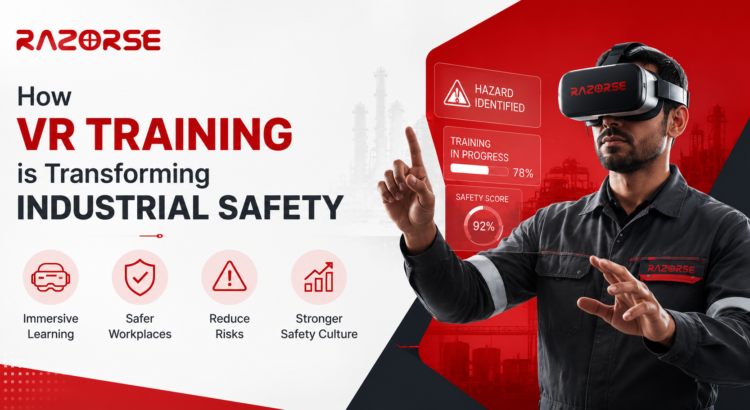
Industrial worker using VR headset for immersive safety training in a manufacturing plant by Razorse

How VR Training is Transforming Industrial Safety

Introduction

Industrial safety training is one of the most important responsibilities for manufacturing organizations. From fire hazards and emergency response procedures to machine handling and hazardous environment awareness, effective training directly impacts employee safety and operational continuity.

However, traditional training methods often struggle to prepare employees for real-world industrial situations. Classroom sessions, manuals, and instructional videos may provide theoretical knowledge, but they rarely create realistic learning experiences.

This is why Virtual Reality (VR) training

is rapidly transforming industrial safety across manufacturing industries.

The Limitations of Traditional Safety Training

Conventional safety training programs face several challenges. Employees often experience low engagement during classroom-based learning sessions, resulting in poor knowledge retention. Since practical exposure is limited, workers may struggle to respond effectively during actual emergencies.

Another major challenge is the inability to simulate dangerous situations safely. Manufacturing organizations cannot repeatedly expose employees to live fire hazards, chemical leaks, or high-risk machinery environments during training sessions.

As a result, employees may understand safety procedures theoretically but lack confidence and preparedness during real incidents.

What is VR-Based Industrial Training?

VR training uses immersive virtual environments to simulate realistic industrial scenarios. Employees wear VR headsets and interact with digitally created workplace situations that closely replicate actual factory environments.

Through VR simulations, employees can practice fire safety procedures, emergency evacuation drills, machine handling operations, hazard identification, safety compliance training, and high-risk operational scenarios.

This allows organizations to provide hands-on learning experiences without exposing employees to actual risks.

Why VR Training is Gaining Popularity

Manufacturing organizations are increasingly adopting VR because immersive learning significantly improves engagement and retention. Employees actively participate in training sessions instead of passively consuming information.

Experiential learning methods help employees remember procedures more effectively compared to traditional presentations or manuals. VR training also allows repeated simulations, enabling workers to practice scenarios multiple times until they gain confidence.

This creates a safer and more prepared workforce.

Key Benefits of VR Training in Manufacturing

One of the biggest advantages of VR training is improved safety awareness. Employees experience realistic industrial situations that help them understand workplace risks more effectively.

VR also improves learning retention because interactive training environments create stronger memory recall compared to traditional methods.

Another important benefit is risk-free practical exposure. Employees can safely practice dangerous procedures without being exposed to actual hazards.

VR training additionally provides standardized learning experiences across the organization. Every employee receives the same quality of training, ensuring consistency and compliance.

Manufacturing organizations also benefit from long-term cost savings by reducing physical training setup costs, minimizing operational disruptions, and lowering incident-related expenses.

VR Training Use Cases in Manufacturing

VR technology is now being used across multiple industrial safety applications.

Fire safety training is one of the most common use cases. Employees can practice emergency evacuation procedures and fire response protocols in highly realistic environments.

VR is also widely used for machine operation training, allowing workers to understand equipment handling procedures before operating actual machinery.

Hazardous environment simulations help employees prepare for chemical leaks, confined space operations, and emergency shutdown procedures safely.

Organizations are also using VR to improve compliance readiness by maintaining digital training records and performance tracking systems.

VR and Industry 4.0

Industry 4.0 is not only about automation and connected machines. It also focuses on building digitally empowered workforces capable of operating advanced industrial systems efficiently and safely.

VR training supports Industry 4.0 initiatives by accelerating workforce upskilling, improving operational safety, enhancing workforce readiness, reducing human errors, and supporting digital transformation strategies.

As factories become smarter, workforce training methods must evolve accordingly.

Real-World Industrial Scenario

Imagine a manufacturing plant conducting emergency fire evacuation training using traditional methods. Organizing live drills may disrupt operations while still failing to replicate real emergency pressure effectively.

With VR training, employees can experience highly realistic emergency scenarios inside a controlled virtual environment. Supervisors can evaluate employee responses, monitor decision-making, and repeat simulations whenever required.

This improves preparedness while minimizing operational disruption.

The Future of Industrial Training

The future of manufacturing training will increasingly rely on immersive technologies such as VR, AI, and simulation-based learning.

Organizations adopting VR training early can achieve safer workplaces, faster onboarding, better compliance management, improved workforce confidence, and reduced operational incidents.

VR is rapidly becoming a key component of smart manufacturing transformation.

Conclusion

Industrial safety training is evolving beyond classrooms and presentations. VR-based learning offers a smarter, safer, and more effective approach to workforce training in modern manufacturing environments.

As Industry 4.0 adoption accelerates, organizations investing in immersive learning technologies will build stronger, safer, and future-ready workforces.

Looking to implement immersive VR-based industrial training solutions for your workforce? Connect with Razorse Software to explore VR safety training designed specifically for modern manufacturing environments.

Enhancing Customer Service with AI Chatbots

In today’s fast-paced digital world, customer expectations are higher than ever. They demand instant responses, personalized interactions, and seamless experiences across platforms. For businesses striving to meet these demands, artificial intelligence (AI) chatbots have emerged as a transformative solution. These virtual assistants not only enhance customer service but also streamline operations, reduce costs, and improve overall efficiency.

The Role of AI in Customer Service

AI chatbots are powered by natural language processing (NLP) and machine learning (ML) technologies, enabling them to understand and respond to human queries in real time. Unlike traditional customer service methods, which often rely on human agents, AI chatbots can handle multiple interactions simultaneously, ensuring 24/7 availability.

Key benefits include:

  • Instant Responses: Chatbots provide immediate answers, eliminating customer wait times.
  • Cost-Effectiveness: By automating routine inquiries, businesses can reduce the workload on customer support teams and lower operational costs.
  • Scalability: Chatbots can manage an unlimited number of customer queries without compromising quality.
  • Data Insights: AI chatbots collect and analyze customer interactions, providing businesses with valuable insights to improve their services.

Personalization at Scale

One of the standout features of AI chatbots is their ability to deliver personalized experiences. By leveraging customer data, such as purchase history and preferences, chatbots can tailor responses to meet individual needs. For example, an eCommerce chatbot can suggest products based on a customer’s browsing history, enhancing the likelihood of a sale.

Moreover, advanced AI chatbots can adapt their tone and language based on the customer’s mood and context, creating a more human-like interaction. This level of personalization fosters trust and strengthens customer relationships, which are crucial for long-term business success.

Use Cases Across Industries

AI chatbots are revolutionizing customer service across various industries:

  1. eCommerce: From answering product queries to processing orders and handling returns, chatbots streamline the online shopping experience.
  2. Healthcare: Virtual assistants can provide appointment scheduling, symptom checking, and post-care follow-ups, ensuring patients receive timely support.
  3. Banking and Finance: AI-powered bots assist with account management, fraud detection, and financial advice, making banking more accessible.
  4. Travel and Hospitality: Chatbots enhance travel planning by providing instant information on bookings, itineraries, and local attractions.
  5. Education: Virtual tutors and administrative chatbots help students with enrolment, course selection, and academic queries.

Overcoming Challenges with AI Chatbots

While the benefits of AI chatbots are undeniable, businesses must address certain challenges to maximize their potential:

  • Language Barriers: Chatbots must support multiple languages to cater to a global audience effectively.
  • Complex Queries: Handling intricate or sensitive issues may require integration with human agents for seamless resolution.
  • Data Security: Protecting customer information is paramount, and businesses must ensure that their chatbots comply with privacy regulations.

To overcome these challenges, businesses should invest in continuous training and updates for their chatbots, ensuring they remain effective and secure over time.

The Future of AI Chatbots in Customer Service

The future of customer service is being shaped by the rapid advancements in AI chatbot technology. As AI continues to evolve, chatbots are becoming smarter, more intuitive, and capable of delivering experiences that closely mimic human interactions. With the integration of voice recognition, sentiment analysis, and predictive analytics, chatbots are no longer limited to answering basic queries, they are transforming into proactive, empathetic virtual assistants.

Imagine a chatbot that not only resolves your customers’ current issues but also anticipates their future needs based on past interactions. For instance, it could remind a customer to renew their subscription or suggest additional services they might find valuable. This proactive approach helps businesses build stronger relationships and foster customer loyalty.

The inclusion of multilingual capabilities is another game-changer, enabling businesses to cater to a global audience without barriers. Additionally, AI-powered bots are increasingly integrating with emerging technologies like augmented reality (AR) and the Internet of Things (IoT), enhancing customer experiences across diverse platforms.

In the years ahead, AI chatbots will become an integral part of business strategies, offering unparalleled support, improving operational efficiency, and empowering businesses to deliver exceptional customer experiences effortlessly.

Let Razorse Software Help You Transform Customer Service with AI

At Razorse Software, we’re passionate about helping businesses redefine customer service with cutting-edge AI solutions. Our AI-powered chatbots aren’t just tools; they’re your round-the-clock support agents, capable of delivering fast, personalized, and seamless experiences that your customers will love.

Whether you’re looking to reduce wait times, handle more queries, or create meaningful interactions, we’ve got you covered. With our tailored approach, we’ll work closely with you to design a solution that fits your unique needs and goals.

Ready to elevate your customer service? Get in touch with Razorse Software today, and let’s build something amazing together!