24/7 Support : info@razorse.com | WhatsApp : +91-7011221090

Agentic AI

Agentic AI in 2026: From AI Assistants to Autonomous Workflows

Agentic AI in 2026: How Businesses Are Moving From AI Assistants to Autonomous Workflows

Artificial intelligence has moved far beyond chatbots and basic AI assistants. In 2026, businesses are increasingly adopting Agentic AI—AI systems that can understand goals, make decisions, use digital tools, and execute multi-step tasks with limited human intervention.

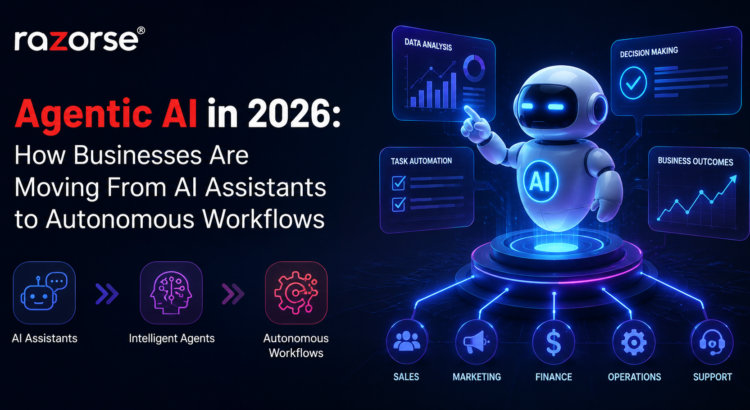
While traditional AI assistants primarily respond to prompts, AI agents are designed to take action. This shift is changing how organizations approach automation, productivity, customer experience, software development, operations, and decision-making.

What Is Agentic AI?

Agentic AI refers to AI systems capable of operating toward a defined objective rather than simply generating a response. An AI agent can analyze information, create a plan, interact with applications, execute tasks, evaluate results, and adjust its approach when necessary.

For example, a traditional AI assistant might help a sales executive write a follow-up email. An AI agent for sales automation could identify leads from a CRM, analyze previous interactions, prioritize prospects, draft personalized emails, schedule follow-ups, update CRM records, and alert the sales team when human intervention is required.

The difference is simple: AI assistants help people complete tasks; Agentic AI can orchestrate entire workflows.

From AI Assistants to Autonomous Workflows

Businesses have already adopted generative AI for content creation, research, customer support, coding, and data analysis. However, many of these applications still depend heavily on human prompts and supervision.

Agentic AI introduces the next layer of automation: goal-driven workflows.

Instead of asking AI to perform every individual step, employees can provide an objective. The AI agent then determines the sequence of actions required to achieve it.

Consider an IT support workflow. A traditional AI chatbot can answer an employee’s question about a technical issue. An agentic system can go further by identifying the problem, checking system logs, creating a support ticket, running approved troubleshooting actions, updating the employee, and escalating the issue to an IT specialist if the problem cannot be resolved automatically.

This creates a more connected and autonomous AI workflow automation environment.

Why Businesses Are Investing in Agentic AI in 2026

One of the biggest reasons for the growing interest in Agentic AI is operational efficiency. Businesses deal with thousands of repetitive processes every day, from data entry and customer follow-ups to document processing and internal reporting.

AI agents can automate these workflows while allowing employees to focus on activities that require creativity, judgment, and strategic thinking.

Key business benefits include:

  • Higher productivity: AI agents can handle repetitive, multi-step processes continuously.
  • Faster decision-making: Agents can analyze large amounts of business data and surface relevant insights quickly.
  • Reduced operational costs: Automating routine workflows can reduce manual effort and process bottlenecks.
  • Improved customer experience: AI-powered systems can provide faster and more personalized interactions.
  • Scalable automation: Businesses can automate processes across departments without increasing manual workload at the same rate.

Where Agentic AI Can Be Used

The potential applications of Agentic AI extend across industries and business functions.

Sales and Marketing

AI agents can qualify leads, personalize outreach, monitor campaign performance, update CRM platforms, and recommend next-best actions. This enables AI-powered sales automation while reducing administrative work for sales teams.

Customer Service

Instead of simply answering FAQs, autonomous AI agents can investigate customer issues, retrieve account information, initiate approved processes, and escalate complex cases to human representatives.

Software Development

Agentic AI can support the software development lifecycle by analyzing requirements, generating code, running tests, identifying bugs, documenting changes, and assisting developers with deployment workflows.

Finance and Operations

Businesses can use AI agents for invoice processing, financial data analysis, reconciliation workflows, reporting, procurement, and operational monitoring.

Human Resources

AI agents can assist with candidate screening, interview scheduling, employee onboarding, document management, and internal HR queries.

Agentic AI Does Not Mean “No Humans”

Despite the word “autonomous,” successful enterprise AI implementation is unlikely to mean removing humans from every workflow.

Instead, the emerging model is human-in-the-loop AI.

Organizations can define permissions, approval requirements, security rules, and escalation points. An AI agent may be allowed to perform low-risk actions automatically while requiring human approval for sensitive decisions.

This approach creates a balance between AI autonomy and human oversight.

The Challenges Businesses Need to Consider

Agentic AI also introduces new challenges. Organizations must consider data privacy, cybersecurity, access permissions, model reliability, compliance, and accountability.

An AI system capable of taking action requires stronger governance than a system that only generates text.

Businesses should therefore establish clear boundaries around what an AI agent can access, what actions it can perform, when human approval is mandatory, and how its decisions are monitored.

The Future of Autonomous AI Workflows

The rise of Agentic AI represents a significant shift in enterprise automation. The question is no longer simply, “How can we use AI?” Instead, businesses are asking, “Which workflows can AI manage from beginning to end?”

In 2026 and beyond, organizations that successfully combine AI agents, business data, automation platforms, and human expertise can build more responsive and efficient operations.

The future of enterprise AI is not just about having smarter assistants. It is about creating intelligent, connected, and autonomous workflows that can turn business goals into action.

Conclusion

Agentic AI is becoming an important evolution in enterprise artificial intelligence. By moving from prompt-based AI assistants to goal-oriented autonomous agents, businesses can automate complex processes, improve productivity, accelerate decision-making, and deliver better customer experiences.

However, successful adoption will depend on more than deploying an AI agent. Companies need the right data, workflows, security controls, governance frameworks, and human oversight.

The businesses that treat Agentic AI as a strategic workflow transformation not simply another AI tool will be better positioned to compete in the next phase of digital transformation.
AI Predictive Maintenance Dashboard

AI Predictive Maintenance: Prevent Equipment Failures

Predictive Maintenance with AI: How Manufacturers Can Prevent Equipment Failures

Manufacturing downtime is expensive. A sudden machine breakdown can disrupt production schedules, increase maintenance costs, delay deliveries, and impact overall operational efficiency. Traditional maintenance approaches such as reactive maintenance and fixed maintenance schedules are no longer enough for modern factories.

This is where AI-powered predictive maintenance is changing the way manufacturers manage equipment.

By combining Artificial Intelligence (AI), Industrial IoT (IIoT), machine learning, and real-time equipment monitoring, manufacturers can identify potential failures before they occur and take corrective action at the right time.


What Is Predictive Maintenance?

Predictive maintenance is a data-driven maintenance strategy that uses equipment data to predict when a machine or component is likely to fail.

Instead of waiting for equipment to break down or servicing machines at predetermined intervals, predictive maintenance continuously monitors machine health and identifies unusual patterns that may indicate an upcoming failure.

AI makes this process more powerful by analyzing large volumes of data from machines, sensors, production systems, and historical maintenance records.

For example, an AI system can detect changes in temperature, vibration, pressure, energy consumption, or operating speed and determine whether these changes indicate normal operation or a potential equipment problem.


How Does AI-Powered Predictive Maintenance Work?

An AI-based predictive maintenance system typically works through four key stages:

1. Real-Time Data Collection

Industrial machines generate huge amounts of operational data. Sensors can monitor parameters such as:

  • Temperature
  • Vibration
  • Pressure
  • Motor speed
  • Energy consumption
  • Noise levels
  • Machine operating hours

Using Industrial IoT (IIoT) technologies, this data can be collected continuously from connected equipment.

2. AI and Machine Learning Analysis

The collected data is analyzed using AI and machine learning algorithms.

These algorithms learn from historical machine behavior and maintenance records to identify patterns associated with equipment degradation or failure.

Instead of simply detecting a threshold violation, AI can identify more complex patterns that may not be obvious through manual monitoring.

3. Anomaly Detection

AI-powered systems can identify abnormal machine behavior in real time.

For example, a machine may still be operating within its normal temperature range, but a combination of increasing vibration, rising energy consumption, and changing operating speed could indicate a developing problem.

AI can recognize these patterns and generate an early warning.

4. Predictive Alerts and Maintenance Action

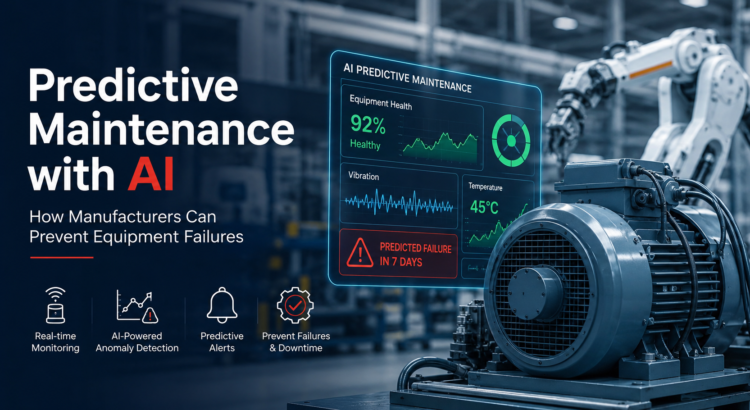
Once the system identifies a potential failure, maintenance teams can receive alerts and insights through an AI dashboard.

This allows engineers to inspect the equipment, schedule maintenance, and replace components before a major breakdown occurs.

The result is a shift from reactive maintenance to proactive, data-driven maintenance.


Key Benefits of Predictive Maintenance in Manufacturing

Reduced Unplanned Downtime

Unexpected equipment failures can bring production lines to a halt. Predictive maintenance helps manufacturers identify potential problems early, reducing the risk of sudden breakdowns and production interruptions.

Lower Maintenance Costs

Traditional preventive maintenance may involve replacing components even when they are still functioning properly. AI-based predictive maintenance enables organizations to perform maintenance based on actual equipment condition, helping optimize maintenance spending.

Improved Equipment Lifespan

Continuous monitoring allows manufacturers to identify abnormal operating conditions before they cause serious damage. Addressing these issues early can help extend the useful life of industrial equipment.

Higher Production Efficiency

Healthy machines operate more consistently. By minimizing unexpected breakdowns and optimizing maintenance schedules, predictive maintenance can contribute to better production efficiency and overall equipment effectiveness.

Better Maintenance Planning

AI-generated insights allow maintenance teams to prioritize equipment that requires attention. Instead of responding to emergencies, teams can plan maintenance activities around production schedules.


AI Predictive Maintenance vs Traditional Maintenance

Traditional maintenance strategies generally fall into two categories: reactive maintenance, where equipment is repaired after failure, and preventive maintenance, where equipment is serviced according to a fixed schedule.

Predictive maintenance takes a different approach.

It uses real-time machine data, historical information, AI analytics, and machine learning to determine when maintenance may actually be required.

This makes maintenance more condition-based and data-driven.


The Role of AI Dashboards in Predictive Maintenance

An AI-powered maintenance dashboard can bring equipment health data into a single interface.

Maintenance managers can monitor machine conditions, identify anomalies, view predictive alerts, analyze historical trends, and prioritize maintenance activities.

This provides decision-makers with a clearer view of factory operations and helps transform complex machine data into actionable insights.


The Future of Predictive Maintenance

As manufacturing becomes increasingly connected, predictive maintenance is expected to become an important component of Industry 4.0 and smart manufacturing.

The combination of AI, IIoT, edge computing, computer vision, and advanced analytics can enable factories to move toward increasingly autonomous equipment monitoring and maintenance.

The future is not simply about detecting when a machine is likely to fail. It is about understanding why the failure may happen, what action should be taken, and how production can be optimized around it.


Conclusion

AI-powered predictive maintenance is helping manufacturers move from reactive equipment management to intelligent, proactive operations.

By continuously analyzing machine data, detecting anomalies, predicting potential failures, and providing actionable insights, AI can help organizations reduce downtime, optimize maintenance costs, improve equipment reliability, and increase operational efficiency.

For manufacturers looking to build smarter and more resilient operations, predictive maintenance is no longer just a future concept—it is becoming a key part of the Industry 4.0 transformation.


Ready to Make Your Manufacturing Operations Smarter?

Razorse helps businesses explore AI, Industrial IoT, automation, and Industry 4.0 solutions designed to improve operational visibility and efficiency.

Connect with Razorse to explore how AI-powered predictive maintenance can transform your manufacturing operations.

Ai-driven Learning PLatform

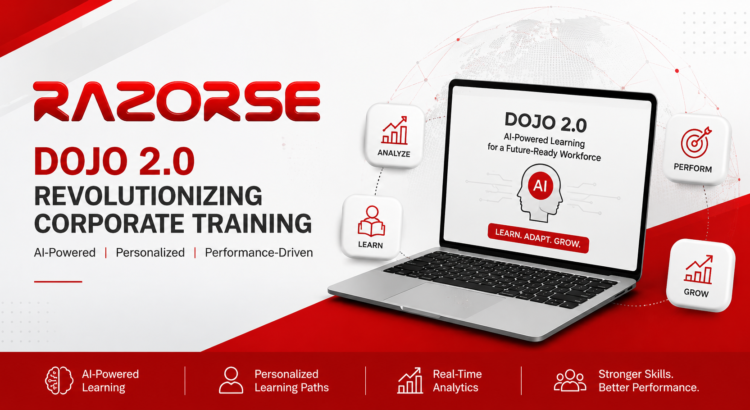
How Dojo 2.0 Is Revolutionizing Corporate Training

In today’s fast-moving business landscape, one thing is clear: employee skills have a shorter shelf life than ever before. New technologies, evolving customer expectations, and rapid digital transformation mean organizations can no longer rely on one-time training sessions to keep their workforce competitive.

Yet, many businesses still struggle with outdated learning methods—long presentations, generic courses, and training programs that employees often forget within weeks.

This is where Dojo 2.0 is changing the game.

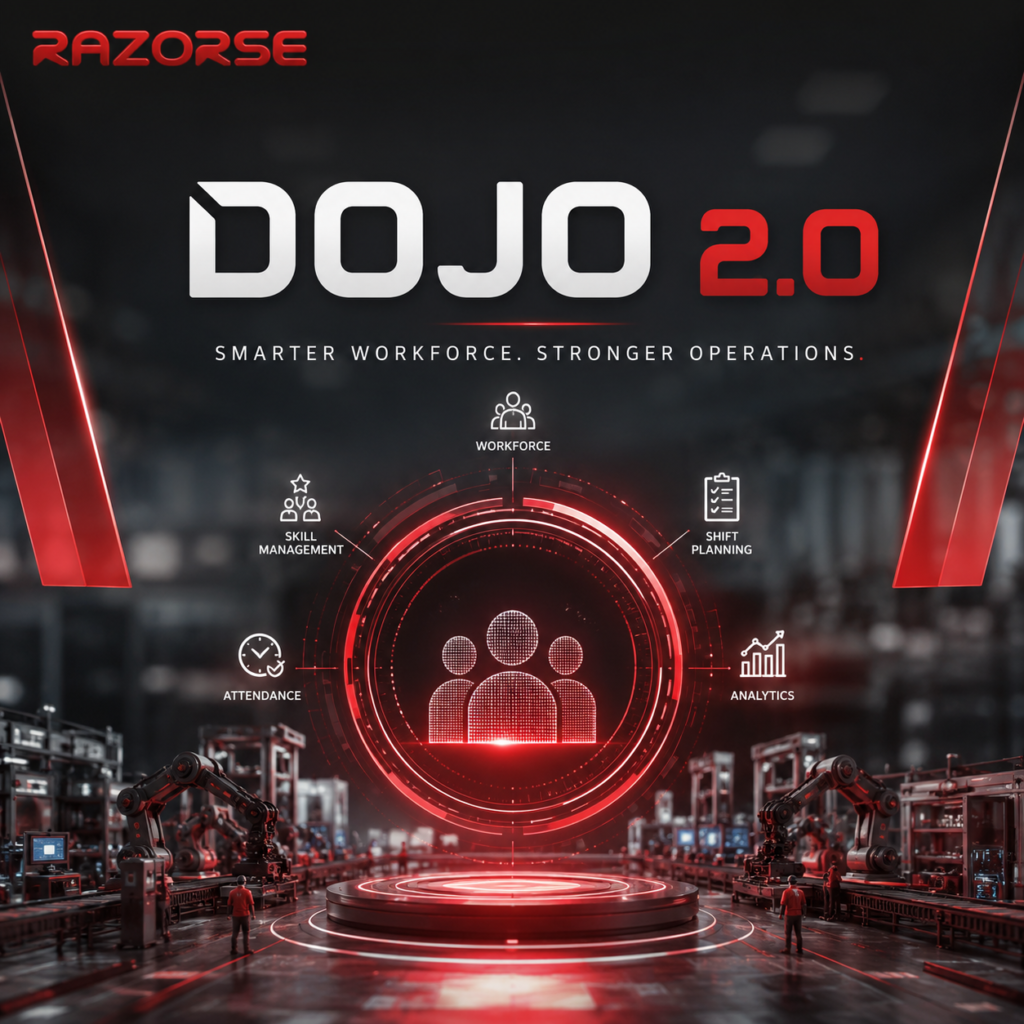
make your workforce smarter with Dojo2.0

As an AI-powered corporate learning platform, Dojo 2.0 goes beyond traditional Learning Management Systems (LMS). It creates personalized, engaging, and data-driven learning experiences that help organizations build future-ready teams while improving productivity and business performance.

The Problem with Traditional Corporate Training

Corporate training has always been essential, but traditional methods are no longer enough.

Most organizations face common challenges such as:

  • Low employee engagement during training sessions.
  • Generic learning paths that don’t cater to individual skill levels.
  • Difficulty measuring learning outcomes.
  • Time-consuming manual training processes.
  • Poor knowledge retention after training is completed.

The result? Companies invest heavily in employee development without achieving measurable improvements in performance.

Modern businesses need learning that evolves alongside their workforce.

How Dojo 2.0 Is Different

Unlike conventional training platforms, Dojo 2.0 uses Artificial Intelligence (AI) to create smarter and more personalized learning journeys.

Instead of delivering the same content to every employee, the platform adapts training based on individual roles, learning progress, strengths, and skill gaps.

This means employees spend less time learning irrelevant information and more time building skills that directly impact their work.

The result is a learning experience that feels less like mandatory training and more like continuous professional growth.

Personalized Learning That Drives Results

Every employee learns differently.

Some prefer short, interactive modules, while others perform better with hands-on simulations or scenario-based learning.

Dojo 2.0 leverages AI-driven personalization to recommend relevant content, adjust learning paths, and deliver training that matches each learner’s pace and objectives.

This personalized approach not only improves engagement but also increases knowledge retention, helping employees apply what they learn in real-world situations.

For organizations, this translates into a more capable, confident, and productive workforce.

Smarter Learning Through Data and Analytics

One of the biggest challenges in corporate training is understanding whether learning is actually making an impact.

Dojo 2.0 solves this by providing real-time learning analytics and performance insights.

Organizations can track:

  • Employee progress
  • Course completion rates
  • Skill development
  • Learning effectiveness
  • Team performance trends

Instead of relying on assumptions, HR and Learning & Development (L&D) teams gain actionable insights that help them continuously optimize training programs and improve business outcomes.

Supporting Digital Transformation Across Industries

Today’s organizations are embracing technologies like Artificial Intelligence (AI), Industry 4.0, Industrial IoT (IIoT), automation, cloud computing, and digital transformation.

However, technology alone doesn’t drive innovation.

People do.

Dojo 2.0 empowers organizations to upskill and reskill employees so they can confidently adapt to new technologies, evolving processes, and changing business requirements.

Whether it’s manufacturing, healthcare, education, retail, logistics, or enterprise services, organizations need a workforce that’s prepared for constant change—and that’s exactly what Dojo 2.0 enables.

Building a Culture of Continuous Learning

Learning shouldn’t stop after onboarding.

The most successful organizations treat employee development as an ongoing journey rather than a one-time event.

Dojo 2.0 encourages continuous learning by making training accessible, engaging, and relevant throughout an employee’s career.

As employees grow their skills, businesses benefit from:

  • Higher productivity
  • Faster adoption of new technologies
  • Improved employee engagement
  • Better retention rates
  • Stronger organizational performance

When learning becomes part of everyday work, innovation naturally follows.

The Future of Corporate Training Starts Here

Corporate training is no longer about completing courses—it’s about building adaptable, future-ready teams.

As businesses continue their digital transformation journey, they need learning platforms that are intelligent, scalable, and capable of evolving with their workforce.

Dojo 2.0 combines AI-powered learning, personalized training, data-driven insights, and continuous skill development to help organizations prepare employees for the challenges of tomorrow.

Because in today’s business world, the companies that invest in smarter learning don’t just build better employees—they build stronger businesses.

Artificial Intelligence is Transforming the Information Technology Industry

Artificial Intelligence (AI) is revolutionizing various sectors, and the Information Technology (IT) industry is at the forefront of this transformation. AI’s capabilities are enhancing IT operations, automating processes, and providing deeper insights through data analysis. This blog explores how AI is transforming the IT industry, focusing on key areas such as IT operations, cybersecurity, software development, and data management.

AI in IT Operations

IT operations have traditionally relied on manual processes and human intervention. However, AI is changing this landscape by introducing automation and intelligence into routine tasks. AI-powered tools and systems can monitor network traffic, predict potential issues, and even resolve problems without human intervention. This not only increases efficiency but also reduces downtime and operational costs.

Enhancing Cybersecurity

Cybersecurity is a critical concern for the IT industry. With the increasing sophistication of cyber threats, traditional security measures are often inadequate. AI is stepping in to bolster cybersecurity by offering advanced threat detection and response capabilities.

AI algorithms can analyse network traffic in real-time, identifying anomalies that may indicate a cyber-attack. Machine learning models are trained on historical data to recognize patterns associated with various types of cyber threats, such as malware, phishing, and ransomware. This enables AI systems to detect and respond to threats faster than human analysts.

Revolutionizing Software Development

Software development is another area where AI is making a profound impact. Traditional software development involves extensive coding, testing, and debugging. AI is streamlining these processes by offering tools that assist developers in writing code, identifying bugs, and optimizing performance.

AI-powered code generation tools, such as GitHub Copilot, use natural language processing (NLP) to understand developers’ instructions and generate code snippets. This can significantly speed up the development process and reduce the likelihood of errors.

In addition to code generation, AI is enhancing software testing. AI-driven testing tools can automatically generate test cases, execute them, and analyse the results. This reduces the time and effort required for testing, allowing developers to focus on more complex tasks. AI can also identify performance bottlenecks and suggest optimizations, ensuring that software runs efficiently.

Improving Data Management

Data is the lifeblood of the IT industry. However, managing vast amounts of data is a challenging task. AI is transforming data management by offering advanced data analytics and automation capabilities.

AI-powered data analytics tools can process and analyse large datasets, extracting valuable insights that would be difficult to obtain through manual analysis. These insights can drive informed decision-making and strategic planning. For instance, AI can analyse customer data to identify trends and preferences, enabling businesses to tailor their products and services to meet customer needs.

AI is also automating data management tasks such as data cleansing, integration, and migration. Machine learning algorithms can identify and correct errors in datasets, ensuring data accuracy and consistency. AI can also streamline data integration processes by automatically mapping and transforming data from different sources.

AI in IT Service Management

IT service management (ITSM) is another area where AI is making significant contributions. AI-powered chatbots and virtual assistants are revolutionizing IT support by providing instant responses to user queries and resolving common issues.

AI chatbots use NLP to understand and respond to user queries in natural language. They can handle a wide range of tasks, from password resets to troubleshooting connectivity issues. This reduces the workload on IT support teams and ensures that users receive timely assistance.

Furthermore, AI is enhancing ITSM by providing predictive analytics. AI algorithms can analyse historical incident data to identify patterns and predict future incidents. This enables IT teams to take proactive measures to prevent incidents, improving service reliability and user satisfaction.

Challenges and Future Directions

While AI offers numerous benefits to the IT industry, it also presents challenges. One major challenge is the need for skilled professionals who can develop, implement, and maintain AI systems. The rapid pace of AI innovation also means that IT professionals must continually update their skills to keep up with new developments.

Another challenge is ensuring the ethical use of AI. AI systems can inadvertently perpetuate biases present in training data, leading to unfair outcomes. Ensuring transparency and accountability in AI decision-making processes is essential to address these concerns.

Looking to the future, AI is expected to continue transforming the IT industry. Advances in AI technologies such as deep learning, reinforcement learning, and quantum computing will drive further innovation. The integration of AI with other emerging technologies, such as the Internet of Things (IoT) and blockchain, will unlock new possibilities and applications.

Final Thoughts

Artificial Intelligence is undoubtedly transforming the Information Technology industry, bringing about significant improvements in efficiency, security, and innovation. From automating IT operations to enhancing cybersecurity, revolutionizing software development, and improving data management, AI is reshaping the IT landscape. As AI continues to evolve, its impact on the IT industry will only grow, driving new opportunities and challenges. Embracing AI and addressing its challenges will be key to staying competitive and leveraging its full potential.