24/7 Support : info@razorse.com | WhatsApp : +91-7011221090

Agentic AI

Agentic AI in 2026: From AI Assistants to Autonomous Workflows

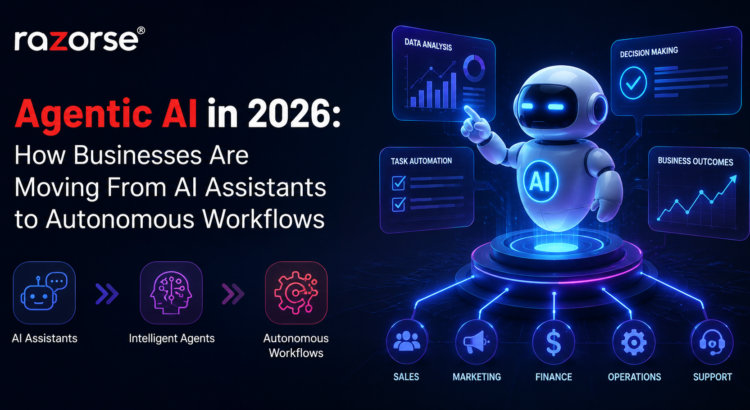
Agentic AI in 2026: How Businesses Are Moving From AI Assistants to Autonomous Workflows

Artificial intelligence has moved far beyond chatbots and basic AI assistants. In 2026, businesses are increasingly adopting Agentic AI—AI systems that can understand goals, make decisions, use digital tools, and execute multi-step tasks with limited human intervention.

While traditional AI assistants primarily respond to prompts, AI agents are designed to take action. This shift is changing how organizations approach automation, productivity, customer experience, software development, operations, and decision-making.

What Is Agentic AI?

Agentic AI refers to AI systems capable of operating toward a defined objective rather than simply generating a response. An AI agent can analyze information, create a plan, interact with applications, execute tasks, evaluate results, and adjust its approach when necessary.

For example, a traditional AI assistant might help a sales executive write a follow-up email. An AI agent for sales automation could identify leads from a CRM, analyze previous interactions, prioritize prospects, draft personalized emails, schedule follow-ups, update CRM records, and alert the sales team when human intervention is required.

The difference is simple: AI assistants help people complete tasks; Agentic AI can orchestrate entire workflows.

From AI Assistants to Autonomous Workflows

Businesses have already adopted generative AI for content creation, research, customer support, coding, and data analysis. However, many of these applications still depend heavily on human prompts and supervision.

Agentic AI introduces the next layer of automation: goal-driven workflows.

Instead of asking AI to perform every individual step, employees can provide an objective. The AI agent then determines the sequence of actions required to achieve it.

Consider an IT support workflow. A traditional AI chatbot can answer an employee’s question about a technical issue. An agentic system can go further by identifying the problem, checking system logs, creating a support ticket, running approved troubleshooting actions, updating the employee, and escalating the issue to an IT specialist if the problem cannot be resolved automatically.

This creates a more connected and autonomous AI workflow automation environment.

Why Businesses Are Investing in Agentic AI in 2026

One of the biggest reasons for the growing interest in Agentic AI is operational efficiency. Businesses deal with thousands of repetitive processes every day, from data entry and customer follow-ups to document processing and internal reporting.

AI agents can automate these workflows while allowing employees to focus on activities that require creativity, judgment, and strategic thinking.

Key business benefits include:

  • Higher productivity: AI agents can handle repetitive, multi-step processes continuously.
  • Faster decision-making: Agents can analyze large amounts of business data and surface relevant insights quickly.
  • Reduced operational costs: Automating routine workflows can reduce manual effort and process bottlenecks.
  • Improved customer experience: AI-powered systems can provide faster and more personalized interactions.
  • Scalable automation: Businesses can automate processes across departments without increasing manual workload at the same rate.

Where Agentic AI Can Be Used

The potential applications of Agentic AI extend across industries and business functions.

Sales and Marketing

AI agents can qualify leads, personalize outreach, monitor campaign performance, update CRM platforms, and recommend next-best actions. This enables AI-powered sales automation while reducing administrative work for sales teams.

Customer Service

Instead of simply answering FAQs, autonomous AI agents can investigate customer issues, retrieve account information, initiate approved processes, and escalate complex cases to human representatives.

Software Development

Agentic AI can support the software development lifecycle by analyzing requirements, generating code, running tests, identifying bugs, documenting changes, and assisting developers with deployment workflows.

Finance and Operations

Businesses can use AI agents for invoice processing, financial data analysis, reconciliation workflows, reporting, procurement, and operational monitoring.

Human Resources

AI agents can assist with candidate screening, interview scheduling, employee onboarding, document management, and internal HR queries.

Agentic AI Does Not Mean “No Humans”

Despite the word “autonomous,” successful enterprise AI implementation is unlikely to mean removing humans from every workflow.

Instead, the emerging model is human-in-the-loop AI.

Organizations can define permissions, approval requirements, security rules, and escalation points. An AI agent may be allowed to perform low-risk actions automatically while requiring human approval for sensitive decisions.

This approach creates a balance between AI autonomy and human oversight.

The Challenges Businesses Need to Consider

Agentic AI also introduces new challenges. Organizations must consider data privacy, cybersecurity, access permissions, model reliability, compliance, and accountability.

An AI system capable of taking action requires stronger governance than a system that only generates text.

Businesses should therefore establish clear boundaries around what an AI agent can access, what actions it can perform, when human approval is mandatory, and how its decisions are monitored.

The Future of Autonomous AI Workflows

The rise of Agentic AI represents a significant shift in enterprise automation. The question is no longer simply, “How can we use AI?” Instead, businesses are asking, “Which workflows can AI manage from beginning to end?”

In 2026 and beyond, organizations that successfully combine AI agents, business data, automation platforms, and human expertise can build more responsive and efficient operations.

The future of enterprise AI is not just about having smarter assistants. It is about creating intelligent, connected, and autonomous workflows that can turn business goals into action.

Conclusion

Agentic AI is becoming an important evolution in enterprise artificial intelligence. By moving from prompt-based AI assistants to goal-oriented autonomous agents, businesses can automate complex processes, improve productivity, accelerate decision-making, and deliver better customer experiences.

However, successful adoption will depend on more than deploying an AI agent. Companies need the right data, workflows, security controls, governance frameworks, and human oversight.

The businesses that treat Agentic AI as a strategic workflow transformation not simply another AI tool will be better positioned to compete in the next phase of digital transformation.
https://razorse.com/blog/digital-skill-matrix-replacing-excel-in-manufacturing-plants/

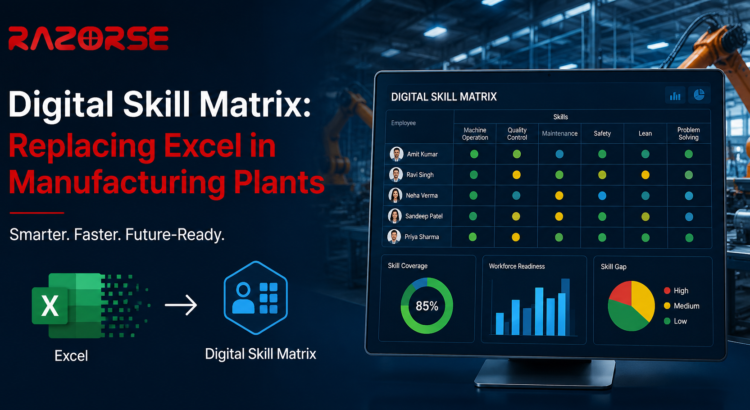
Digital Skill Matrix: Replacing Excel in Manufacturing Plants

Introduction

Manufacturing industries are rapidly moving toward automation, smart factories, and Industry 4.0-driven operations. While production systems are becoming more advanced, many organizations still rely on outdated Excel sheets to manage workforce skills, certifications, training records, and competency tracking. Although spreadsheets may have worked in the past, they are no longer capable of supporting the speed, complexity, and scale of modern manufacturing environments.

Today’s manufacturing leaders require real-time workforce visibility, faster decision-making, better compliance management, and data-driven workforce planning. This is where digital skill matrix systems are becoming essential.

A digital skill matrix helps organizations track employee competencies, identify skill gaps, improve productivity, and simplify workforce management through a centralized digital platform.

The Challenges of Manual Skill Tracking

In many manufacturing plants, workforce competency management still depends heavily on spreadsheets and manual reporting systems. HR teams and plant managers often maintain separate Excel files for certifications, machine handling capabilities, safety training records, and employee skill levels. Over time, this creates operational inefficiencies and data inconsistencies.

One of the biggest problems with Excel-based tracking is the lack of real-time updates. Employee data can quickly become outdated, making it difficult for management teams to identify current workforce capabilities accurately. Manual data entry also increases the chances of human errors, duplicate records, and missing information.

During audits or compliance reviews, retrieving updated workforce records from multiple spreadsheets becomes time-consuming and stressful. In industries such as automotive and engineering manufacturing, where compliance and safety standards are critical, this can create serious operational risks.

Why Workforce Skill Visibility Matters

Modern factories require highly skilled and adaptable employees capable of working with automated systems, robotics, ERP platforms, and smart manufacturing technologies. As Industry 4.0 adoption increases, workforce competency becomes directly linked to operational efficiency and productivity.

Without clear visibility into employee skills and certifications, organizations struggle with improper workforce allocation, delayed production schedules, training inefficiencies, compliance risks, and reduced productivity.

A digital skill matrix enables organizations to manage workforce readiness proactively instead of reacting to operational challenges after they occur.

What is a Digital Skill Matrix?

A digital skill matrix is a centralized platform that tracks workforce competencies, certifications, training progress, and employee proficiency levels in real time. Unlike static spreadsheets, digital systems provide automated updates, centralized visibility, and actionable insights for workforce planning.

These systems help organizations monitor employee skills across departments, identify competency gaps instantly, track training and certification status, improve workforce planning, simplify compliance management, and generate real-time reports and dashboards.

This creates a more structured and intelligent approach to workforce management.

Key Benefits of Digital Skill Matrix Systems

One of the biggest advantages of digital skill matrix platforms is improved workforce productivity. Managers can instantly identify skilled employees for specific operations, reducing delays and improving resource utilization.

Digital systems also strengthen compliance management by automatically tracking certifications, safety training renewals, and mandatory workforce requirements. Instead of manually monitoring expiry dates, organizations receive automated alerts and updates.

Another major benefit is faster employee upskilling. By identifying skill gaps clearly, HR and training teams can create targeted learning programs instead of conducting generalized training sessions. This improves workforce competency while reducing unnecessary training costs.

Additionally, digital platforms reduce dependency on manual administrative work. Centralized systems eliminate the need for maintaining multiple spreadsheets and improve collaboration across departments.

How DOJO 2.0 Supports Workforce Digitization

As manufacturing operations become more complex, organizations require intelligent workforce management solutions that align with Industry 4.0 goals. DOJO 2.0 is designed to help manufacturing companies digitize workforce competency management efficiently.

The platform enables organizations to track employee skills, certifications, training records, and workforce readiness through a centralized digital system. Instead of relying on disconnected spreadsheets, companies gain real-time visibility into workforce performance and competency levels.

DOJO 2.0 helps organizations digitize workforce management processes, improve operational visibility, identify workforce gaps quickly, strengthen compliance readiness, improve workforce productivity, and support data-driven decision-making.

This creates a smarter and more scalable workforce management ecosystem for modern manufacturing plants.

Real-World Manufacturing Scenario

Consider an automotive manufacturing plant operating multiple production lines across different shifts. Employees may require different certifications for machine handling, safety operations, and quality processes. Managing this information manually across spreadsheets becomes highly inefficient.

With a digital skill matrix, supervisors can instantly identify which employees are certified for specific machines, which workers require retraining, which teams have competency shortages, and which certifications are about to expire.

This improves workforce allocation, minimizes production disruptions, and ensures operational continuity.

The Future of Workforce Management

The future of manufacturing will depend heavily on workforce digitization and intelligent operational systems. Companies that continue relying on spreadsheets may struggle to manage growing operational complexity effectively.

Digital workforce management systems are becoming essential for Industry 4.0 transformation, smart factory implementation, AI-driven manufacturing operations, workforce optimization, and compliance management.

Organizations investing in workforce digitization today will build stronger operational foundations for the future.

Conclusion

Excel sheets are no longer sufficient for managing workforce competency in modern manufacturing environments. Digital skill matrix systems provide the visibility, efficiency, and intelligence required for effective workforce management.

By adopting platforms like DOJO 2.0, manufacturing organizations can improve productivity, strengthen compliance, reduce operational inefficiencies, and prepare their workforce for Industry 4.0 transformation.

Looking to replace manual workforce tracking with a smarter digital solution? Connect with Razorse Software to explore how DOJO 2.0 can help your manufacturing plant digitize workforce competency management and improve operational efficiency.