24/7 Support : info@razorse.com | WhatsApp : +91-7011221090

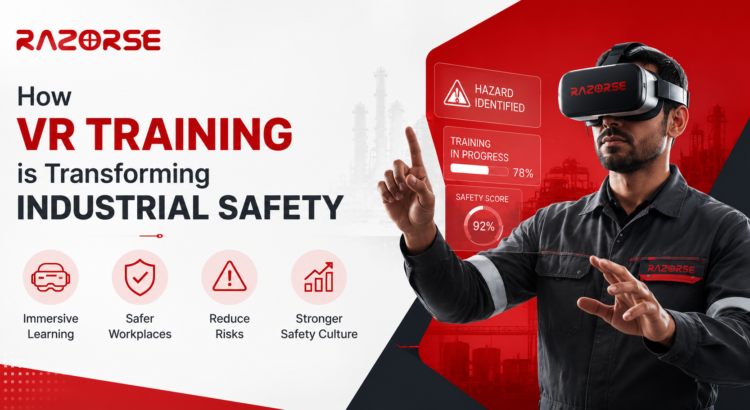
Industrial worker using VR headset for immersive safety training in a manufacturing plant by Razorse

How VR Training is Transforming Industrial Safety

Introduction

Industrial safety training is one of the most important responsibilities for manufacturing organizations. From fire hazards and emergency response procedures to machine handling and hazardous environment awareness, effective training directly impacts employee safety and operational continuity.

However, traditional training methods often struggle to prepare employees for real-world industrial situations. Classroom sessions, manuals, and instructional videos may provide theoretical knowledge, but they rarely create realistic learning experiences.

This is why Virtual Reality (VR) training

is rapidly transforming industrial safety across manufacturing industries.

The Limitations of Traditional Safety Training

Conventional safety training programs face several challenges. Employees often experience low engagement during classroom-based learning sessions, resulting in poor knowledge retention. Since practical exposure is limited, workers may struggle to respond effectively during actual emergencies.

Another major challenge is the inability to simulate dangerous situations safely. Manufacturing organizations cannot repeatedly expose employees to live fire hazards, chemical leaks, or high-risk machinery environments during training sessions.

As a result, employees may understand safety procedures theoretically but lack confidence and preparedness during real incidents.

What is VR-Based Industrial Training?

VR training uses immersive virtual environments to simulate realistic industrial scenarios. Employees wear VR headsets and interact with digitally created workplace situations that closely replicate actual factory environments.

Through VR simulations, employees can practice fire safety procedures, emergency evacuation drills, machine handling operations, hazard identification, safety compliance training, and high-risk operational scenarios.

This allows organizations to provide hands-on learning experiences without exposing employees to actual risks.

Why VR Training is Gaining Popularity

Manufacturing organizations are increasingly adopting VR because immersive learning significantly improves engagement and retention. Employees actively participate in training sessions instead of passively consuming information.

Experiential learning methods help employees remember procedures more effectively compared to traditional presentations or manuals. VR training also allows repeated simulations, enabling workers to practice scenarios multiple times until they gain confidence.

This creates a safer and more prepared workforce.

Key Benefits of VR Training in Manufacturing

One of the biggest advantages of VR training is improved safety awareness. Employees experience realistic industrial situations that help them understand workplace risks more effectively.

VR also improves learning retention because interactive training environments create stronger memory recall compared to traditional methods.

Another important benefit is risk-free practical exposure. Employees can safely practice dangerous procedures without being exposed to actual hazards.

VR training additionally provides standardized learning experiences across the organization. Every employee receives the same quality of training, ensuring consistency and compliance.

Manufacturing organizations also benefit from long-term cost savings by reducing physical training setup costs, minimizing operational disruptions, and lowering incident-related expenses.

VR Training Use Cases in Manufacturing

VR technology is now being used across multiple industrial safety applications.

Fire safety training is one of the most common use cases. Employees can practice emergency evacuation procedures and fire response protocols in highly realistic environments.

VR is also widely used for machine operation training, allowing workers to understand equipment handling procedures before operating actual machinery.

Hazardous environment simulations help employees prepare for chemical leaks, confined space operations, and emergency shutdown procedures safely.

Organizations are also using VR to improve compliance readiness by maintaining digital training records and performance tracking systems.

VR and Industry 4.0

Industry 4.0 is not only about automation and connected machines. It also focuses on building digitally empowered workforces capable of operating advanced industrial systems efficiently and safely.

VR training supports Industry 4.0 initiatives by accelerating workforce upskilling, improving operational safety, enhancing workforce readiness, reducing human errors, and supporting digital transformation strategies.

As factories become smarter, workforce training methods must evolve accordingly.

Real-World Industrial Scenario

Imagine a manufacturing plant conducting emergency fire evacuation training using traditional methods. Organizing live drills may disrupt operations while still failing to replicate real emergency pressure effectively.

With VR training, employees can experience highly realistic emergency scenarios inside a controlled virtual environment. Supervisors can evaluate employee responses, monitor decision-making, and repeat simulations whenever required.

This improves preparedness while minimizing operational disruption.

The Future of Industrial Training

The future of manufacturing training will increasingly rely on immersive technologies such as VR, AI, and simulation-based learning.

Organizations adopting VR training early can achieve safer workplaces, faster onboarding, better compliance management, improved workforce confidence, and reduced operational incidents.

VR is rapidly becoming a key component of smart manufacturing transformation.

Conclusion

Industrial safety training is evolving beyond classrooms and presentations. VR-based learning offers a smarter, safer, and more effective approach to workforce training in modern manufacturing environments.

As Industry 4.0 adoption accelerates, organizations investing in immersive learning technologies will build stronger, safer, and future-ready workforces.

Looking to implement immersive VR-based industrial training solutions for your workforce? Connect with Razorse Software to explore VR safety training designed specifically for modern manufacturing environments.

Read our blog

The Impact of Artificial Intelligence on the Evolution of Technology

Artificial Intelligence (AI) has been a game-changer in the realm of technology, profoundly transforming various sectors and redefining how we interact with the world. From its nascent stages to its current prominence, the evolution of artificial intelligence has been marked by rapid advancements and widespread integration into numerous industries. This blog explores the impact of artificial intelligence and technology on our lives, with a particular focus on AI in healthcare, AI in finance, and the broader implications of this revolutionary technology.

The Evolution of Artificial Intelligence

The journey of artificial intelligence began in the mid-20th century, with foundational work by pioneers like Alan Turing and John McCarthy. Initially, AI was a theoretical concept explored in academic circles and depicted in science fiction. However, with the advent of more powerful computing resources and sophisticated algorithms, AI transitioned from theory to practice. The evolution of artificial intelligence has been characterized by significant milestones, including the development of machine learning (ML), natural language processing (NLP), and neural networks.

AI in Healthcare

One of the most impactful applications of artificial intelligence and technology is in the healthcare sector. AI in healthcare has revolutionized diagnostics, treatment plans, and patient care. Machine learning algorithms analyse vast amounts of medical data to identify patterns and predict outcomes with remarkable accuracy.

For instance, AI-powered systems can examine medical images to detect early signs of diseases such as cancer. This early detection capability significantly improves patient outcomes by allowing for timely intervention. Additionally, AI-driven tools assist in personalizing treatment plans based on a patient’s unique genetic makeup, lifestyle, and medical history.

AI in Finance

The financial sector is another area where artificial intelligence and technology have made a significant impact. AI in finance has transformed how financial institutions operate, offering benefits such as improved risk management, fraud detection, and personalized customer services.

In risk management, AI algorithms analyse market trends, economic indicators, and historical data to predict potential risks and opportunities. This predictive capability enables financial institutions to make informed decisions, minimizing losses and maximizing gains. AI in finance also enhances fraud detection by monitoring transactions in real-time and identifying suspicious activities, thereby protecting both institutions and customers.

Personalized customer service is another critical application of AI in finance. Chatbots and virtual assistants powered by AI provide instant support to customers, addressing their queries and offering tailored financial advice. This not only improves customer satisfaction but also reduces operational costs for financial institutions.

Broader Implications of Artificial Intelligence and Technology

The integration of artificial intelligence and technology is not limited to healthcare and finance. Its influence extends across various industries, driving innovation and efficiency. In the retail sector, AI enhances the shopping experience through personalized recommendations and efficient inventory management. E-commerce platforms like Amazon use AI to analyse customer behaviour and offer tailored product suggestions, boosting sales and improving customer satisfaction.

In manufacturing, AI-driven automation has led to increased productivity and reduced costs. Robots powered by AI perform repetitive tasks with precision, while predictive maintenance minimizes downtime by forecasting equipment failures. The transportation industry, too, is experiencing a revolution with AI-powered autonomous vehicles. Self-driving cars use AI to navigate, interpret traffic signals, and avoid obstacles, promising safer and more efficient transportation.

Ethical and Societal Considerations

While the benefits of artificial intelligence and technology are undeniable, they also raise important ethical and societal concerns. One major issue is job displacement due to automation. As AI systems become more capable, there is a risk that human labour will be rendered redundant in certain sectors. However, this also creates opportunities for new jobs in AI development, maintenance, and oversight.

Privacy is another critical concern. AI systems often require access to large amounts of personal data to function effectively. Ensuring that this data is collected, stored, and used responsibly is paramount to protecting individuals’ privacy and preventing misuse. Additionally, bias in AI algorithms is a significant issue. AI systems trained on biased data can perpetuate and even exacerbate existing inequalities. Addressing these biases requires diverse datasets and continuous monitoring to ensure fair outcomes.

The Future of Artificial Intelligence

The future of artificial intelligence holds immense potential. As technology continues to evolve, AI is expected to play an even more integral role in shaping our world. Advancements in AI research may lead to the development of artificial general intelligence (AGI), machines with human-like cognitive abilities. This could revolutionize fields such as scientific research, where AI could accelerate discoveries and solve complex problems beyond human capabilities.

In education, AI-powered adaptive learning systems can tailor educational content to individual students’ needs, improving learning outcomes. In entertainment, AI can create more immersive and interactive experiences, from personalized content recommendations to virtual reality environments.

Conclusion

The effect of artificial intelligence on the evolution of technology is profound and far-reaching. From revolutionizing industries like healthcare and finance to transforming daily life, AI’s capabilities are continually expanding, driving innovation and efficiency. As we navigate the ethical and societal implications of AI, it is essential to harness its potential responsibly, ensuring that it benefits all of humanity. The future of technology is undoubtedly intertwined with the advancements of AI, promising a world where intelligent machines augment human abilities and unlock new possibilities.