24/7 Support : info@razorse.com | WhatsApp : +91-7011221090

Sustainability Through IT: How Digital Tools Are Driving Green Manufacturing

Sustainability has become a defining priority for modern manufacturing. With rising energy costs, global climate commitments, and stricter environmental regulations, the pressure to reduce waste and optimize resources is greater than ever. Today, Information Technology sits at the centre of this transformation. Digital tools are enabling manufacturers to monitor energy consumption, reduce material waste, modernize processes, and build long-term eco-friendly systems. Through intelligent data, automation, and connected infrastructure, IT is shaping a new era of green manufacturing where sustainability naturally aligns with profitability.

1. Real-Time Energy Monitoring for Smarter Consumption
Traditional factories relied on manual logs and periodic audits to track energy usage, which often led to reactive and delayed decisions. Modern IoT sensors and smart meters now provide real-time insights into electricity, fuel, water, steam, and machine-level consumption. Manufacturers can immediately detect irregularities, identify energy-heavy equipment, and reduce unnecessary load. Combined with analytics dashboards, these systems highlight trends like peak usage hours, standby power wastage, and seasonal variations. This real-time visibility empowers factories to optimize scheduling, shut down idle systems, and adopt energy-efficient practices with precision.

2. AI-Based Energy Optimization and Predictive Forecasting
AI has become a powerful ally in the drive toward sustainability. Predictive models analyze historical energy patterns to forecast future demand, enabling manufacturers to balance loads, shift operations to off-peak hours, and avoid high-consumption periods. AI also identifies equipment that consumes more power over time due to wear and tear, allowing timely intervention. By providing automated recommendations-such as adjusting temperature settings, optimizing machine cycles, or modifying load distribution-AI ensures that energy is used efficiently, reducing both cost and carbon footprint.

3. Minimizing Material Waste Through Digital Twins and Automation
Waste reduction is one of the biggest sustainability challenges in manufacturing. Digital twins solve this by creating virtual replicas of machines, products, or full production lines. Manufacturers can simulate processes, test new setups, and optimize workflows without using real materials. This reduces trial-and-error waste significantly. Automation further improves material efficiency by ensuring consistent quality, reducing errors, and minimizing rework. With robotic precision, automated systems avoid defects that often lead to large-scale scrap, contributing directly to a more sustainable production model.

4. Smarter Quality Control With Machine Vision and AI
Quality control is no longer a manual, error-prone step. AI-powered vision systems now inspect products at high speed and with microscopic accuracy. These systems detect defects in real time-such as cracks, mismatches, color variations, or structural inconsistencies-before the issues progress further down the production line. This early detection reduces defective batches, avoids material wastage, and maintains consistency. Machine learning models also identify recurring defect patterns, enabling manufacturers to fix root causes and create long-term quality improvements.

5. Cloud-Based Infrastructure for Low-Carbon IT Operations
Sustainability isn’t only about what happens on the factory floor. IT infrastructure itself contributes to the environmental footprint. Moving to cloud platforms dramatically reduces the need for heavy on-premise servers, cooling systems, and hardware maintenance-all of which consume energy. Cloud ecosystems store data efficiently, support remote monitoring, and allow seamless integration of new sustainability tools without additional physical resources. This shift to cloud not only cuts carbon emissions but also ensures real-time coordination between global teams, improving decision-making and reducing operational delays.

6. Automated ESG Reporting and Sustainability Compliance
Environmental, Social, and Governance (ESG) compliance is now a global requirement. Companies must report emissions, energy use, waste generation, water consumption, and sustainability initiatives with accuracy. IT systems simplify this process by automating data collection and generating real-time ESG dashboards. Instead of spending days compiling spreadsheets, manufacturers can instantly view their environmental performance metrics. Automated reporting also reduces human error and supports transparency, helping organizations stay compliant with government policies and customer expectations. These insights help companies set realistic targets and monitor progress year-round.

Together, these digital advancements are reshaping manufacturing into a more intelligent, eco-conscious, and resource-efficient industry. Green manufacturing is no longer limited to isolated initiatives-it is becoming an integrated, measurable, and continuous part of modern operations. Factories of the future will rely heavily on data, automation, and connected systems to maintain sustainability as a core business outcome rather than an optional responsibility.

At Razorse Software, we empower manufacturers to accelerate this transformation with advanced digital solutions tailored for sustainable operations. Our expertise in IoT-based monitoring, predictive analytics, cloud platforms, automation, and ESG reporting tools helps organizations build greener, smarter, and more efficient production environments. With Razorse, companies can reduce energy costs, eliminate unnecessary waste, streamline operations, and achieve long-term sustainability goals without compromising performance. By integrating the right digital technologies at the right scale, Razorse enables manufacturers to move confidently toward a future where sustainability and operational excellence go hand in hand.

#Sustainability #GreenManufacturing #DigitalTransformation #Industry40 #SmartFactories #EnergyEfficiency #WasteReduction #SustainableTech #ManufacturingInnovation #CleanTech #IoTInManufacturing #AIForSustainability #RazorseSoftware #GreenIT #ESGReporting #FutureOfManufacturing #EcoFriendlyTech #SustainableOperations #AutomationSolutions #CloudTransformation
Digital Transformation in Auto Manufacturing: Role of AR Solutions!

The automotive industry has always been at the forefront of innovation, from the introduction of assembly lines to the adoption of robotics in production. Today, the next major shift in the industry is being driven by digital transformation-a change powered by smart technologies like the Internet of Things (IoT), Artificial Intelligence (AI), data analytics, and Augmented Reality (AR).

Among these, AR has emerged as one of the most impactful tools, blending the physical and digital worlds to enhance everything from design to production, training, and maintenance. Auto manufacturers around the world are increasingly realizing how AR can make their operations faster, safer, and more efficient.

Understanding AR in the Manufacturing Context

Augmented Reality (AR) overlays digital information-such as 3D models, diagrams, or data-on top of real-world objects through a smartphone, tablet, or AR headset. Unlike Virtual Reality (VR), which creates an entirely digital environment, AR enhances the physical environment with interactive digital elements.

In automotive manufacturing, this capability means that engineers, designers, and technicians can visualize, analyse, and modify complex machinery or vehicle components in real time, without needing physical prototypes or printed manuals. It’s a leap toward smarter, data-driven production lines.

1. Enhancing Product Design and Prototyping

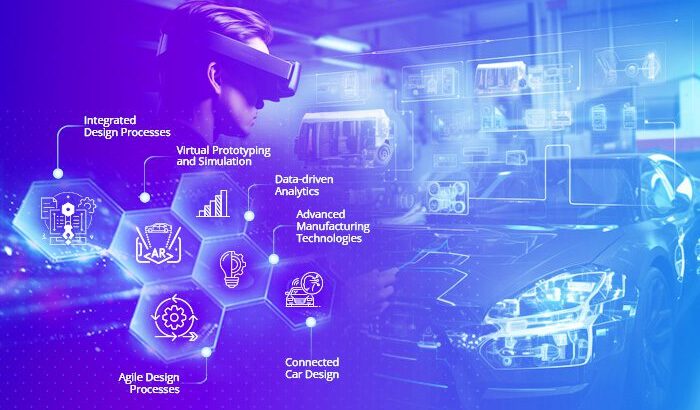
Before a car hits the production floor, it goes through several design and testing phases. Traditionally, creating prototypes involved expensive materials and long development cycles. AR changes that by allowing designers to project 3D models of vehicles or components onto real-world surfaces, making it possible to test form, fit, and functionality virtually.

Teams can collaborate remotely, examine design flaws instantly, and make necessary adjustments without building multiple prototypes. This approach not only reduces costs but also accelerates innovation cycles, allowing automakers to bring new models to market faster.

2. Improving Production and Assembly Line Efficiency

AR is proving to be a game-changer on the factory floor. Assembly line workers can wear AR glasses or use tablets to receive step-by-step instructions projected directly onto the parts they’re working on. This eliminates the need for paper manuals and reduces human error significantly.

For example, if a technician is assembling an engine component, the AR system can highlight which bolt to tighten next, display torque specifications, or warn if a part is placed incorrectly. Such real-time visual guidance boosts productivity, ensures precision, and enhances worker safety-all critical elements in auto manufacturing.

3. Streamlining Maintenance and Quality Assurance

Machine downtime is a major issue in the automotive sector, where every minute lost translates into production delays and financial losses. AR solutions are helping maintenance teams minimize these disruptions. By using AR glasses, technicians can visualize the internal structure of complex machinery, identify faulty components, and follow guided repair procedures without dismantling entire systems unnecessarily.

Additionally, AR-driven quality assurance enables inspectors to overlay digital CAD models onto physical parts to detect deviations, misalignments, or defects in real time. This immediate feedback loop allows manufacturers to maintain stringent quality standards while reducing rework.

4. Transforming Workforce Training and Skill Development

The automotive industry is witnessing a skills gap as new technologies demand different capabilities from the workforce. AR-based training programs are bridging this gap effectively. Instead of relying on lengthy classroom sessions or trial-and-error learning on the production floor, new employees can use AR headsets to experience immersive, hands-on simulations.

Trainees can learn to assemble complex vehicle systems, understand safety procedures, or even practice troubleshooting-all in a risk-free virtual environment. This not only improves retention and confidence but also allows organizations to train large teams quickly and consistently.

5. Enabling Remote Assistance and Collaboration

Global auto manufacturers often operate across multiple plants and geographies. When an issue arises in one location, having an expert on-site can be time-consuming and expensive. AR enables remote collaboration, where specialists can see exactly what the on-site worker is viewing through their AR device and guide them in real time.

This real-time visual communication accelerates problem-solving, reduces travel costs, and keeps production lines running smoothly. It’s a vital component in maintaining agility in today’s globally connected manufacturing environment.

6. Data Integration and Predictive Insights

AR, when combined with IoT and AI, takes digital transformation to another level. For instance, AR interfaces can display live performance data from sensors installed on machines, helping operators identify potential issues before they escalate. Predictive maintenance powered by AR ensures that machines are serviced at optimal times, reducing downtime and extending their lifespan.

This seamless integration of AR with data analytics enables manufacturers to make informed, proactive decisions-shifting from reactive repairs to predictive management.

The Road Ahead for AR in Auto Manufacturing

The adoption of AR in auto manufacturing is still growing, but the benefits are already evident. From concept to customer delivery, AR is making processes more connected, intelligent, and efficient. As AR hardware becomes more affordable and software solutions more customizable, the barriers to entry are quickly diminishing.

Future innovations could include AI-driven AR assistants, real-time analytics dashboards, and fully integrated digital twins-allowing manufacturers to simulate, visualize, and optimize every stage of vehicle production in a unified digital ecosystem.

Conclusion

AR is no longer a futuristic concept-it’s a vital part of the digital transformation journey for the automotive industry. By merging the physical and digital worlds, AR is redefining how vehicles are designed, built, and maintained. Manufacturers who embrace this technology are not just improving operational efficiency but also building resilience, agility, and a stronger competitive edge in an evolving marketplace.

At Razorse Software, we help automotive companies accelerate their digital transformation by developing innovative AR-based and data-driven solutions that enhance productivity, efficiency, and business growth.


#DigitalTransformation #AugmentedReality #AutoManufacturing #ARSolutions #RazorseSoftware #Industry40 #SmartManufacturing #Innovation

AI vs Human Intelligence: What’s the Real Difference?

AI vs Human Intelligence: What’s the Real Difference?

We live in a world where machines can learn, adapt, and even respond in ways that mimic human thought. Artificial Intelligence (AI) is no longer science fiction — it’s embedded in our phones, homes, businesses, and decisions. But amid all the buzz, one question keeps coming back: How does AI really compare to human intelligence?

Let’s explore the core differences between AI and the human brain — and why both are essential in the evolving digital age.

1. Definition: Brain vs. Algorithm

Human intelligence refers to the cognitive abilities of humans — including learning from experience, understanding abstract concepts, emotional reasoning, problem-solving, and creativity. It’s deeply tied to consciousness, morality, and emotions.

Artificial Intelligence, on the other hand, is the simulation of human intelligence by machines. It includes capabilities like pattern recognition, language processing, decision-making, and predictive analytics — all powered by data and algorithms, not emotions or consciousness.

In simple terms, humans think; AI computes.

2. Learning and Experience

Humans learn organically through experiences, senses, and interactions. A child learns to walk not just by instruction but by falling, observing, and trying again. We learn from emotion, intuition, and error.

AI learns through data. It’s fed millions of examples, and through models like machine learning and deep learning, it identifies patterns. But here’s the catch: AI only knows what it’s trained on. A self-driving car may recognize a pedestrian, but it doesn’t feel fear if someone jumps into traffic.

Humans generalize from minimal examples. AI needs thousands.

3. Emotion and Empathy

This is one of the biggest gaps.

Humans can understand context, express empathy, feel joy, pain, and relate to others emotionally. Our decisions are influenced by ethics, empathy, or even a “gut feeling.”

AI doesn’t possess true emotions. It may simulate empathy (like a chatbot responding, “I’m sorry to hear that”), but it doesn’t feel sorrow or concern. Its “understanding” is based on rules and programmed patterns.

This makes AI useful for data-driven tasks — but limited when emotional intelligence or moral judgment is needed.

4. Creativity and Innovation

Human intelligence can create art, compose music, write poetry, and invent solutions from seemingly nothing. Creativity isn’t always logical — it often breaks the rules.

AI, on the other hand, creates based on patterns and training data. It can generate music, paintings, or write articles (like this one), but it works within predefined limits. It’s not truly inventing; it’s remixing and replicating styles.

AI may mimic Van Gogh, but only a human could invent impressionism.

5. Adaptability and Intuition

Humans are remarkably adaptable. We can switch between tasks, solve problems in new ways, and make decisions with little information. Our brains can handle ambiguity.

AI struggles with unexpected inputs. While advancements in general AI aim to fix this, most AI systems today are narrow — excellent at one task but poor at adapting.

For example, an AI trained to play chess can’t drive a car. But a human can switch from driving to cooking dinner to solving a math problem — all in the same hour.

6. Speed and Accuracy

This is where AI shines.

Machines process vast amounts of data in seconds. AI can analyze millions of documents, detect trends, and generate insights faster than any human ever could. It doesn’t get tired, bored, or distracted.

In sectors like finance, healthcare, or logistics, AI drastically improves efficiency and accuracy. While a doctor might miss a rare disease, an AI trained on thousands of case studies might catch it in an instant.

Here, human intelligence complements AI — offering context, empathy, and final judgment.

7. Ethics and Decision-Making

Humans apply morality and social norms in decision-making. We debate, consider consequences, and sometimes act selflessly.

AI decisions depend on how it’s programmed. Bias in data can lead to biased outcomes — an issue seen in facial recognition or hiring algorithms. AI lacks a conscience.

This raises a vital point: AI shouldn’t replace human judgment in areas involving ethics, rights, or justice — it should assist, not decide.

So, Who Wins?

It’s not about AI vs. humans. It’s about AI with humans.

AI enhances productivity, helps us make better decisions, and handles repetitive or data-heavy tasks. But the spark of innovation, empathy, moral reasoning, and adaptability — that still belongs to humans.

Rather than fearing AI, we must focus on collaboration. When we combine human intelligence with artificial intelligence, we unlock the true potential of progress.

Final Thoughts from Razorse Software

At Razorse Software, we believe the future lies in building digital tools that empower humans, not replace them. Our AI-powered solutions are designed to boost business intelligence, automate repetitive tasks, and support strategic decision-making — all while keeping the human element at the centre.

Whether you’re exploring AI for your enterprise or curious about its role in digital transformation, we’re here to guide you every step of the way.

Let’s innovate — together.

#ArtificialIntelligence #HumanIntelligence #AIvsHuman #RazorseSoftware #DigitalTransformation #Innovation #AIWithHumans #FutureOfWork #TechForGood #MachineLearning

Beyond the Buzz: What Industry 4.0 really means for your Business!

The world is changing – not gradually, but at an exponential pace. What we’re experiencing is not just another era of improvement but a seismic shift that’s transforming how we work, produce, and live. Welcome to Industry 4.0 – the Fourth Industrial Revolution.

But what exactly does it mean? And more importantly, how does it affect your business, your technology, and your future?

Let’s break it down.

The Evolution to Industry 4.0

To understand Industry 4.0, it helps to understand what came before.

  • Industry 1.0 was the dawn of mechanization in the 18th century. Think steam engines, looms, and water-powered factories.
  • Industry 2.0 arrived with mass production and electricity in the early 20th century, creating assembly lines and large-scale manufacturing.
  • Industry 3.0 brought automation and computers in the late 20th century. Machines began to operate with less human intervention.

Now, Industry 4.0 takes things to the next level by combining physical production with digital technologies like IoT (Internet of Things), AI (Artificial Intelligence), Machine Learning, Big Data, Cloud Computing, and Cyber-Physical Systems. It’s not just about smarter machines – it’s about intelligent ecosystems.

What Industry 4.0 Really Means

At its core, Industry 4.0 is about interconnectivity, automation, real-time data, and intelligent decision-making. Factories are becoming “smart” – using data from connected devices to monitor performance, predict failures, optimize production, and even self-adjust in real-time.

Imagine a manufacturing floor where every machine talks to the others, learns from performance data, and adjusts to keep efficiency high and waste low. Or a supply chain where logistics systems autonomously reroute shipments based on weather, traffic, and demand – all without human input.

This is not science fiction. This is the here and now.

The Key Pillars of Industry 4.0

Industry 4.0 is driven by a powerful convergence of digital technologies. At the forefront is the Internet of Things (IoT), where connected sensors and devices collect real-time data across operations, from materials tracking to equipment monitoring. Complementing this is Big Data and Analytics, which processes massive volumes of structured and unstructured data to uncover actionable insights that fuel smarter, faster decision-making. Artificial Intelligence (AI) and Machine Learning (ML) take this data further by enabling systems to learn, predict, and adapt – optimizing production, forecasting maintenance needs, and improving service delivery. Cloud Computing supports all this by offering scalable, flexible, and cost-effective infrastructure. Adding intelligence to physical environments are Cyber-Physical Systems, which merge machines with software and sensors to enable autonomous decision-making. Finally, Additive Manufacturing (3D Printing) is reshaping production itself, allowing for customized, on-demand creation of components with precision and minimal waste.

Industry 4.0 in Action

Let’s take a real-world example. A smart factory powered by Industry 4.0 technologies can:

  • Monitor equipment health and schedule predictive maintenance before a breakdown occurs.
  • Track inventory in real time, automating replenishment based on demand trends.
  • Use AI-powered quality control, spotting defects more accurately than the human eye.
  • Respond to supply chain disruptions quickly by using autonomous decision-making systems.

It’s not just manufacturing that benefits. Retail, healthcare, logistics, agriculture, and even smart cities are tapping into Industry 4.0 principles to deliver better outcomes faster and more efficiently.

Why It matters for your business

Embracing Industry 4.0 isn’t just a technological upgrade – it’s a strategic move that transforms how businesses operate and compete. Organizations that adopt Industry 4.0 can benefit from a significant boost in productivity and product quality, lower operational costs through automation, quicker time-to-market for their offerings, improved customer satisfaction thanks to greater customization, and enhanced flexibility and innovation driven by data insights and adaptive systems. In short, it’s the difference between surviving and thriving in a hyper-digital world.

Moving into the future

We don’t just help businesses adapt – we help them evolve. With deep expertise in IoT, AI/ML, cloud solutions, and intelligent automation, Razorse Software create future-ready ecosystems that empower companies to innovate, scale, and compete in the Industry 4.0 era. Whether you’re just getting started or ready to elevate your digital infrastructure, our tailored solutions ensure your journey is seamless, strategic, and built for long-term growth.

The next chapter of innovation starts here.

#Industry40 #DigitalTransformation #IoT #AI #SmartManufacturing #FutureOfWork #Innovation #BusinessTransformation #TechForTomorrow #SmartSolutions #RazorseSoftware

Why a Mobile E-Commerce App is Essential for Your Business

In today’s fast-paced digital world, consumers are more inclined to shop online than ever before. The convenience of browsing, selecting, and purchasing products from the palm of their hands has transformed the way businesses operate. While having a responsive website is crucial, a dedicated mobile e-commerce app takes customer experience to the next level. It offers speed, accessibility, and personalization that a website alone cannot achieve. If you want to stay competitive and maximize your business potential, investing in a mobile e-commerce app is no longer optional—it’s essential.

One of the biggest advantages of a mobile app is the seamless user experience it provides. Unlike mobile websites, which often depend on browser performance and internet speed, apps are built for smooth navigation and faster load times. Customers can quickly browse through products, save items in their cart, and complete purchases without facing lag or disruptions. Moreover, apps can function offline to some extent, allowing users to access certain features without an active internet connection. This level of convenience enhances customer satisfaction, leading to increased sales and brand loyalty.

Another key benefit of a mobile e-commerce app is its ability to offer personalized shopping experiences. With access to user data such as browsing history, preferences, and purchase behavior, businesses can curate product recommendations tailored to individual customers. Push notifications play a vital role in keeping users engaged by sending alerts about discounts, new arrivals, and special promotions. This direct line of communication helps businesses stay connected with their customers, increasing the likelihood of repeat purchases. Unlike emails or social media ads, which can be easily ignored, app notifications create a more immediate and engaging interaction with the audience. Security and trust are also major factors influencing online shopping behavior. A well-developed e-commerce app with secure payment gateways reassures customers that their transactions are safe. Features like biometric authentication (fingerprint or face recognition) further enhance security, making the checkout process faster and more reliable. Many consumers are wary of entering card details repeatedly on websites, but an app allows for securely stored payment methods, reducing friction during transactions. This convenience encourages customers to complete purchases without hesitation.

A mobile app also provides businesses with a competitive edge by fostering brand visibility and loyalty. Once installed, the app icon remains on the user’s device, serving as a constant reminder of the brand. This presence increases the chances of repeat visits and purchases. Additionally, loyalty programs integrated within the app—such as reward points, exclusive member discounts, or early access to sales—help retain customers and encourage them to shop more frequently. Unlike a website, which requires customers to open a browser and search for your store, an app is just one tap away, making the shopping journey effortless. For businesses looking to scale, a mobile e-commerce app offers valuable insights into customer behavior and preferences. Advanced analytics tools can track user engagement, purchase patterns, and popular products, helping businesses make data-driven decisions. Understanding what works and what doesn’t allows companies to optimize their marketing strategies and improve their product offerings. The ability to adapt quickly to customer demands ensures long-term success in an increasingly competitive market.

Additionally, mobile apps provide an opportunity for businesses to integrate emerging technologies such as augmented reality (AR) and artificial intelligence (AI) to enhance the shopping experience. AR allows customers to visualize products before purchasing, such as trying on clothes or placing furniture in their homes virtually. AI-powered chatbots improve customer service by offering instant responses and personalized assistance. Such innovations set brands apart and create a more immersive and interactive shopping experience.

Incorporating a mobile e-commerce app into your business strategy is not just about keeping up with trends—it’s about creating a superior shopping experience that meets modern consumer expectations. With the right features, such as seamless navigation, personalized recommendations, secure payments, and loyalty programs, an app can drive sales and enhance customer satisfaction. In an era where convenience and speed define purchasing decisions, businesses that prioritize mobile apps are the ones that will thrive.

Take Your Business to the Next Level with Razorse Software
At Razorse Software, we specialize in developing high-performance mobile e-commerce apps that transform businesses. Whether you’re a startup or an established brand, our team ensures a seamless, secure, and engaging shopping experience for your customers. Let’s build the perfect app for your business – #EcommerceSolutions #MobileAppDevelopment #RazorseSoftware #DigitalGrowth #FutureOfShopping.

Enhancing Customer Service with AI Chatbots

In today’s fast-paced digital world, customer expectations are higher than ever. They demand instant responses, personalized interactions, and seamless experiences across platforms. For businesses striving to meet these demands, artificial intelligence (AI) chatbots have emerged as a transformative solution. These virtual assistants not only enhance customer service but also streamline operations, reduce costs, and improve overall efficiency.

The Role of AI in Customer Service

AI chatbots are powered by natural language processing (NLP) and machine learning (ML) technologies, enabling them to understand and respond to human queries in real time. Unlike traditional customer service methods, which often rely on human agents, AI chatbots can handle multiple interactions simultaneously, ensuring 24/7 availability.

Key benefits include:

  • Instant Responses: Chatbots provide immediate answers, eliminating customer wait times.
  • Cost-Effectiveness: By automating routine inquiries, businesses can reduce the workload on customer support teams and lower operational costs.
  • Scalability: Chatbots can manage an unlimited number of customer queries without compromising quality.
  • Data Insights: AI chatbots collect and analyze customer interactions, providing businesses with valuable insights to improve their services.

Personalization at Scale

One of the standout features of AI chatbots is their ability to deliver personalized experiences. By leveraging customer data, such as purchase history and preferences, chatbots can tailor responses to meet individual needs. For example, an eCommerce chatbot can suggest products based on a customer’s browsing history, enhancing the likelihood of a sale.

Moreover, advanced AI chatbots can adapt their tone and language based on the customer’s mood and context, creating a more human-like interaction. This level of personalization fosters trust and strengthens customer relationships, which are crucial for long-term business success.

Use Cases Across Industries

AI chatbots are revolutionizing customer service across various industries:

  1. eCommerce: From answering product queries to processing orders and handling returns, chatbots streamline the online shopping experience.
  2. Healthcare: Virtual assistants can provide appointment scheduling, symptom checking, and post-care follow-ups, ensuring patients receive timely support.
  3. Banking and Finance: AI-powered bots assist with account management, fraud detection, and financial advice, making banking more accessible.
  4. Travel and Hospitality: Chatbots enhance travel planning by providing instant information on bookings, itineraries, and local attractions.
  5. Education: Virtual tutors and administrative chatbots help students with enrolment, course selection, and academic queries.

Overcoming Challenges with AI Chatbots

While the benefits of AI chatbots are undeniable, businesses must address certain challenges to maximize their potential:

  • Language Barriers: Chatbots must support multiple languages to cater to a global audience effectively.
  • Complex Queries: Handling intricate or sensitive issues may require integration with human agents for seamless resolution.
  • Data Security: Protecting customer information is paramount, and businesses must ensure that their chatbots comply with privacy regulations.

To overcome these challenges, businesses should invest in continuous training and updates for their chatbots, ensuring they remain effective and secure over time.

The Future of AI Chatbots in Customer Service

The future of customer service is being shaped by the rapid advancements in AI chatbot technology. As AI continues to evolve, chatbots are becoming smarter, more intuitive, and capable of delivering experiences that closely mimic human interactions. With the integration of voice recognition, sentiment analysis, and predictive analytics, chatbots are no longer limited to answering basic queries, they are transforming into proactive, empathetic virtual assistants.

Imagine a chatbot that not only resolves your customers’ current issues but also anticipates their future needs based on past interactions. For instance, it could remind a customer to renew their subscription or suggest additional services they might find valuable. This proactive approach helps businesses build stronger relationships and foster customer loyalty.

The inclusion of multilingual capabilities is another game-changer, enabling businesses to cater to a global audience without barriers. Additionally, AI-powered bots are increasingly integrating with emerging technologies like augmented reality (AR) and the Internet of Things (IoT), enhancing customer experiences across diverse platforms.

In the years ahead, AI chatbots will become an integral part of business strategies, offering unparalleled support, improving operational efficiency, and empowering businesses to deliver exceptional customer experiences effortlessly.

Let Razorse Software Help You Transform Customer Service with AI

At Razorse Software, we’re passionate about helping businesses redefine customer service with cutting-edge AI solutions. Our AI-powered chatbots aren’t just tools; they’re your round-the-clock support agents, capable of delivering fast, personalized, and seamless experiences that your customers will love.

Whether you’re looking to reduce wait times, handle more queries, or create meaningful interactions, we’ve got you covered. With our tailored approach, we’ll work closely with you to design a solution that fits your unique needs and goals.

Ready to elevate your customer service? Get in touch with Razorse Software today, and let’s build something amazing together!